
Retire Often
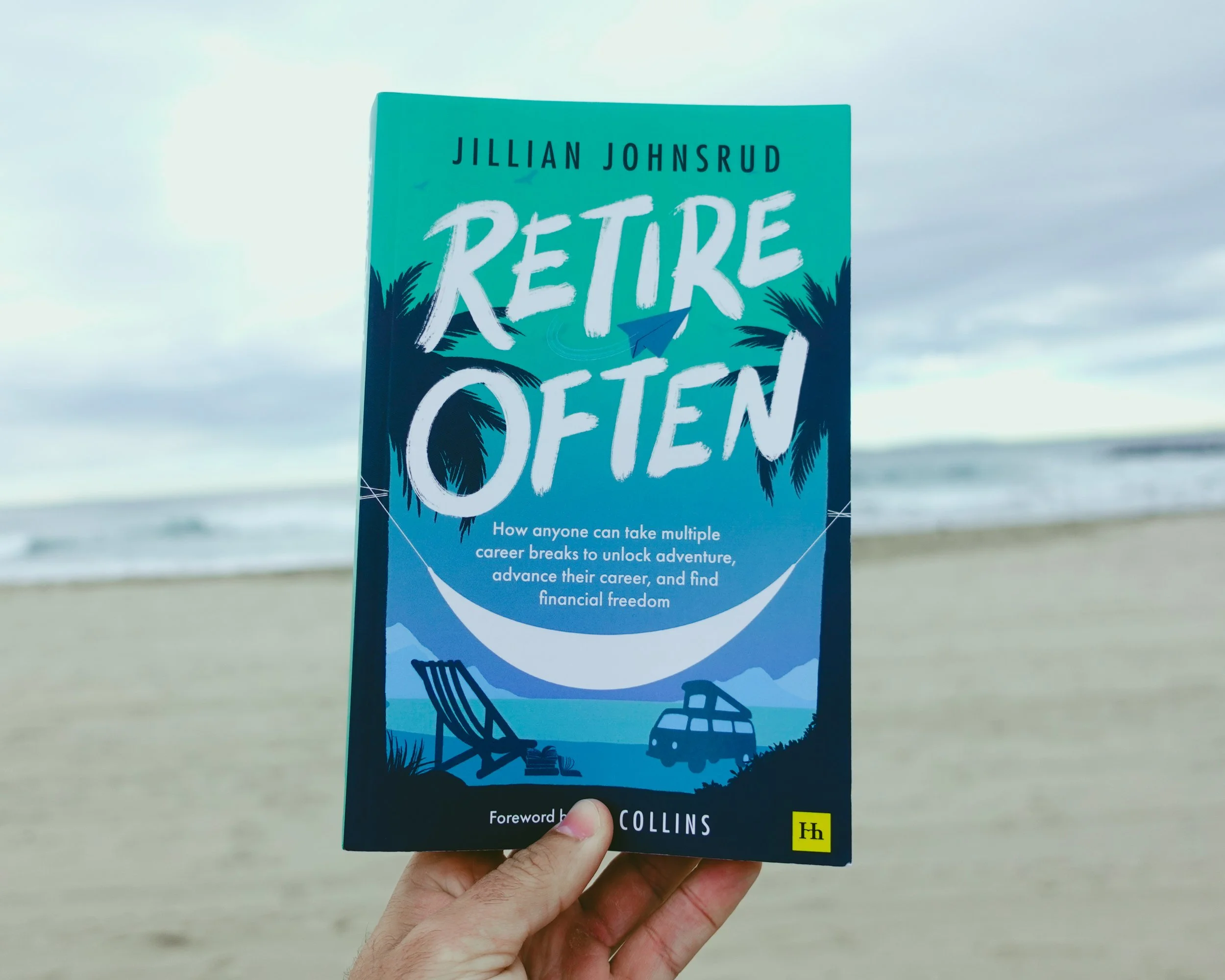
Click here to buy the book.🚀 The Book in 3 Sentences
Retire Often shows how taking intentional career breaks can open the door to more adventure, more growth, and more financial freedom.
The book challenges the conventional routine of a 40-year grind followed by a single retirement, arguing instead that stepping away from work can actually help you enhance the parts of your life that matter most.
Drawing from her own series of mini-retirements, the author makes the case that pausing your career doesn’t set you back—more often than not, it actually propels you forward.
🧠 Key Takeaways
A desire for something different — to not be stuck on the conveyor belt your entire life — is something that motivates all investors. It’s at the root of why you’re investing in the first place, and as Warren Buffett said, “If you don’t find a way to make money in your sleep, you will work until you die.”
A fear of suddenly having to make decisions on what to do with your life keeps people in their jobs longer than they probably need to be. It’s just easier to hand your time over to someone else than it is to figure out how you actually want to spend it.
If you’re not happy with where you’re at in life — financially or otherwise — it is on you to change that. Come up with a plan, create a budget, and start putting your extra money to work. If you can do that and adhere to it, time will take care of the rest.
You don’t want to look back on your life someday and regret not doing certain things when you had the chance — especially if the only reason you didn’t do them was because you had to work. Nobody on their deathbed looks back and thinks, “Man, I wish I’d spent more time at the office.”
While retirement is about not having to go to work, that’s really only half of it. The other half is about living the life you’ve always wanted to, but haven’t had the time for.
The First Chapter Career is not fun, but it puts you in a stronger financial position and sets you up for whatever comes next. The Second Chapter Career is basically the opposite. You’ve already paid your dues in the first chapter, and now this one is about doing something that actually aligns with your skillset and interests, even though it may not pay as well.
Sometimes you need a bad experience to light a fire under you. It’s difficult to improve your situation when you’re too comfortable in the one you’re in.
Most people assume that having a critical role at work means you’re stuck. But in reality, the fact that you’re needed is actually a competitive advantage.
At the end of the day, like most things, you need balance. You need to be financially mindful of the future — assuming you’ll actually be around for it — while not shutting yourself off from actually living your life today.
✍️ Memorable Quotes
“The system is broken. Be a kid for five years. Train for your job for 12-20 years. Work your job for 40 years. Then, if you are lucky and still healthy, you get to fit in all the things you missed out on. There are some obvious flaws to this plan.”
I call this “the conveyor belt of life,” and I remember feeling myself wanting something different pretty early on — probably around 21 or 22, before I’d even had my first real job.
That desire to step off the conveyor belt is what pushed me into my early entrepreneurial ventures. None of them really worked out, but each one led to the next thing, which led to the next thing after that, which eventually led me to start my YouTube channel after becoming interested in investing.
And I really think that desire for something different — to not be stuck on the conveyor belt your entire life — is something that motivates all investors. It’s at the root of why you’re investing in the first place, and as Warren Buffett said, “If you don’t find a way to make money in your sleep, you will work until you die.”
With that said, it’s cool to know that there are other options, and that you can give yourself a taste of financial freedom along the way through the mini-retirements described in this book.
“Finding ways to organize your time, develop hobbies, and find meaning and purpose outside of your work is a learning curve. For most of your life, someone else told you how to organize your time and defined success, first at school, then at a job. They gave you clear goals, rewarded you with incentives, and let you know where to be, what to focus on, and how much time it should take. In retirement, no one will create the structure or write the rules for you. It’s up to you. And you might not have any practice. Creating a life you love takes time, intention, and experimentation. You have to figure out what brings you joy. You need to invest in relationships. You discover the thing that creates a sense of progress.”
From what I’ve encountered, one of the biggest problems most retirees run into — and one of the main things that keeps them from retiring sooner — is that they have no idea what to do with all that free time.
For most of their lives, they were told where to be, stayed there most of the day, and never really had to think about how to spend their time because someone else always filled it for them.
That fear of suddenly having to make those decisions themselves keeps people in their jobs longer than they probably need to be. It’s just easier to hand your time over to someone else than it is to figure out how you actually want to spend it.
That’s where these mini-retirements can be so useful. They can be a low-stakes way to test-drive retirement and get a feel for how you might fill that time.
Instead of staying in their jobs out of fear of the unknown, people might actually find themselves itching to retire sooner because they won’t feel lost about what comes next.
“Money isn’t something that happens to you. You create the financial plans, and you make them happen.”
Obviously, there are exceptions to this. Some people really do come into money without having to work for it.
But generally speaking, anything worthwhile in life takes diligent effort. You have to put in the work, and building wealth is no different.
With that said, if you’re not happy with where you’re at in life — financially or otherwise — it is on you to change that. Come up with a plan, create a budget, and start putting your extra money to work.
If you can do that and adhere to it, time will take care of the rest.
“If we are honest with ourselves, some things in life don’t have a five- or ten-year shelf life. They have to be done when they have to be done. Or there’ll be no doing them. Seasons in life have an expiration date.”
There are simply some things in life — like hiking Machu Picchu or snorkeling in the Great Barrier Reef — that you just can’t do once you reach a certain age. The older you get, the more likely it is that physical limitations start getting in the way.
You don’t want to look back on your life someday and regret not doing those things when you had the chance — especially if the only reason you didn’t do them was because you had to work. Nobody on their deathbed looks back and thinks, “Man, I wish I’d spent more time at the office.”
“The single biggest mistake I see people make in planning their mini-retirements sounds like this, ‘As long as I’m not working, I’ll be happy! Anything is better than my current situation.’ The difference between a personally life-changing mini-retirement and a mediocre one is about three hours of brainstorming.”
It’s easy to think of retirement as nothing more than just “getting away” from a job you don’t like. You tell yourself that as long as you don’t have to go to work, you’ll be happy.
But sitting around doing nothing is not a lasting recipe for happiness. Sure, you might be thrilled to not clock into that job you can’t stand, but having no purpose or structure can end up making you even unhappier — and honestly a lot more bored — than you were at that sucky job.
With that said, while retirement is about not having to go to work, that’s really only half of it. The other half is about living the life you’ve always wanted to, but haven’t had the time for.
It’s the hobbies you’ve wanted to try, the projects you’ve wanted to start, the trips you’ve wanted to take, and the friends and family you haven’t had the chance to see.
At the end of the day, retirement isn’t just about getting away from something bad — it’s also about getting into something good.
“A First Chapter Career is about earning the most possible, paying off debt, and building a foundation of financial security. A Second Chapter Career isn’t just optimizing for the most money. In a Second Chapter Career, people often want more purpose. They want work that aligns with their skill set and passions. They want time and space for the things they value: health, family, hobbies. They want to work with interesting people and do interesting things. Even if it pays less.”
Some jobs, you admittedly take just for the money. Maybe you don’t enjoy the work all that much, and maybe the hours are long, but the pay is good.
That’s the First Chapter Career. It’s not fun, but it puts you in a stronger financial position and sets you up for whatever comes next.
The Second Chapter Career is basically the opposite. You’ve already paid your dues in the first chapter, and now this one is about doing something that actually aligns with your skillset and interests, even though it may not pay as well.
“If an employer thinks so poorly of the fact that you have people you care about outside of work, interests, goals, or hobbies, maybe they aren’t the right fit for you.”
I actually had a job like this once, where my boss would call or text me out of nowhere — late at night, in the middle of a weekend, even when I was on vacation after I’d already made sure everything was handled before I left.
There was zero respect for any part of my life outside of that job. It sucked, and it started bleeding into every other part of my life.
Looking back, that’s the closest I’ve ever felt to being depressed. And if I’m being honest, I probably was.
Oddly enough, that job ended up serving a very important purpose. If I hadn’t been that miserable, I don’t think I would’ve been motivated to start investing in the first place — my attempt to dig myself out of the cruddy situation I was in.
Unfortunately, sometimes you need a bad experience like that to light a fire under you. It’s difficult to improve your situation when you’re too comfortable in the one you’re in.
“People often view having a critical role in a company, or possessing deep industry knowledge, as a reason they would never be granted time off. In reality, those factors make it most costly and time-consuming to replace you.”
It’s funny because most people assume that having a critical role at work means you’re stuck. You think that taking time off would be impossible because everything would fall apart without you.
But in reality, the fact that you’re needed is actually a competitive advantage. The more essential you are, the harder you are to replace, which means you usually have more leverage than you think.
“There are books on how life is short, and YOLO. Those simple, extreme narratives often win. But I think you should want both. Security and freedom. Because people who only have one might say they are happy, but there is an undercurrent of fear.”
First of all, life is short. We tell ourselves it’s not, but when you look back, you start to realize just how much time has passed without you even noticing it. I’m only 32, and I’m already feeling that.
With that said, a lot of people take that idea — that life is short and tomorrow isn’t guaranteed — and use it almost like permission to live entirely for the present. Take the trip, buy the car, run up the bill at the restaurant… with no thought about what any of that means later.
On the other side, you have people like many of us investors who lean way too far in the opposite direction. Instead of living for right here, right now, we’re constantly thinking about the future.
We tell ourselves: I can’t spend money on XYZ because I need to set it aside for later. Everything becomes about financial security in the future.
At the end of the day, like most things, you need balance. You need to be financially mindful of the future — assuming you’ll actually be around for it — while not shutting yourself off from actually living your life today.
It’s a tough balance to strike, but that’s where I think budgeting really helps. Budgeting gives you a way to do both at the same time.
You can set aside what your future self needs, and whatever’s left over becomes your personal free cash flow to use however you want, letting you enjoy today without sacrificing tomorrow.


Retire Often shows how taking intentional career breaks can open the door to more adventure, more growth, and more financial freedom.