BIG NEWS For Realty Income (O)
PRESENTED BY SNOWBALL ANALYTICS
Disclaimer: This page contains some affiliate links that might just lead you to the promised land of awesomeness (or at least some cool products). I may receive commissions for purchases made through links in this post.
Realty Income (O) announced a pretty big deal earlier this week, and as both a Las Vegas local and a shareholder, I’m pretty excited about it.
They’re investing $800 million into CityCenter in Las Vegas, which includes the ARIA and Vdara hotels located center Strip. These are huge, high-end properties owned by Blackstone and operated by MGM.
Fun fact: I actually met up with PPC Ian at the Aria a couple of months back (picture below).

Now, the interesting thing about this $800 million they’re investing is that they actually aren’t getting an ownership stake in either hotel. Blackstone will still maintain full ownership, and MGM will still run the operations just like they do today.
Instead, Realty Income is taking what’s called a preferred equity position, which sits in a sweet spot right between a loan and ownership.
The easiest way to think about preferred equity is this: Realty Income is essentially giving Blackstone the money and earning a locked-in 7.4% return every year. It sounds a lot like interest on a loan — and in some ways, it is — but the big difference is that there’s no fixed payback date.
In other words, there’s no schedule where Blackstone has to return the money, and there’s no maturity like a traditional loan. Realty Income can just collect that income forever unless Blackstone buys them out.
That element of perpetuity is what makes it equity instead of debt, but it isn’t common equity either. Like I said earlier, Blackstone still owns all of that.
Realty Income doesn’t get voting rights, they don’t control the property, and they don’t share in the gains if Blackstone sells the property to someone else. (Although on that note, Realty Income does have the right of first offer if Blackstone ever decides to sell their common equity stake.)
What they do get, though, is priority. Because they’re in the preferred position, Realty Income gets its 7.4% before Blackstone takes a penny of profit.
What makes this structure even more attractive is that the returns will also grow over time. Starting after year five, Realty Income’s returns will automatically increase through built-in escalators.
And if Blackstone ever decides to buy them out, Realty Income is guaranteed at least an 8.325% IRR on whatever portion is redeemed, plus early redemption penalties in the first few years.
Now with all of that said, this deal isn’t their first rodeo with Blackstone on the Strip. A couple of years ago, they acquired a 20% stake in the Bellagio — just a couple hotels over — which tells you this isn’t some random, one-off deal. There’s a pattern forming here.
We’ve been seeing Realty Income shift a bit from their bread-and-butter triple-net retail acquisitions toward these larger, more creative deals where they can deploy large chunks of capital all at once.
And to be fair, some of that is probably out of necessity. The company is so big now that small retail deals just don’t move the needle anymore. A giant can’t live off crumbs.
That aside, I think this is objectively a great deal and an awesome group of assets to be involved with. Through this investment, Realty Income is adding a protected and predictable income stream that helps the company in its mission to provide stable and growing cash flow to shareholders.
For a business that has branded itself as “The Monthly Dividend Company,” I think this deal makes sense.
Do you own any shares of Realty Income? Write to me here and let me know.
Dividend Investing Democratized
Join thousands of savvy investors in the pursuit of early retirement. Get Retire With Ryne delivered straight to your inbox every week as you build your perpetually growing, cash-flowing dividend stock portfolio.

One of the most essential tools for any investor is a reliable portfolio tracker, and Snowball Analytics is the ultimate command center for your portfolio, providing all the tools you need (and more) in one place.
Plus, it’s one of the only portfolio trackers out there designed specifically for dividend investors.
The layout is clean and intuitive, offering charts, graphs, and other features you didn’t even know you needed but now can’t live without—like the dividend calendar, portfolio backtest tool, and the dip finder tool (this has been a game changer).
I’ve been using Snowball for a couple of years now, and it's the most in-depth portfolio tracker I’ve ever used (you can see my entire portfolio on Snowball here). I highly recommend it to any dividend investor looking for maximum functionality and data for tracking their portfolio.
Right now, Snowball Analytics is offering a 14-day FREE trial so you can try it out risk-free. The best part is, if you end up loving it (which, as you'll find out, is not hard to do), you can save 10% on your subscription when you use code “rynewilliams” upon signing up.
IN MY PORTFOLIO 📈
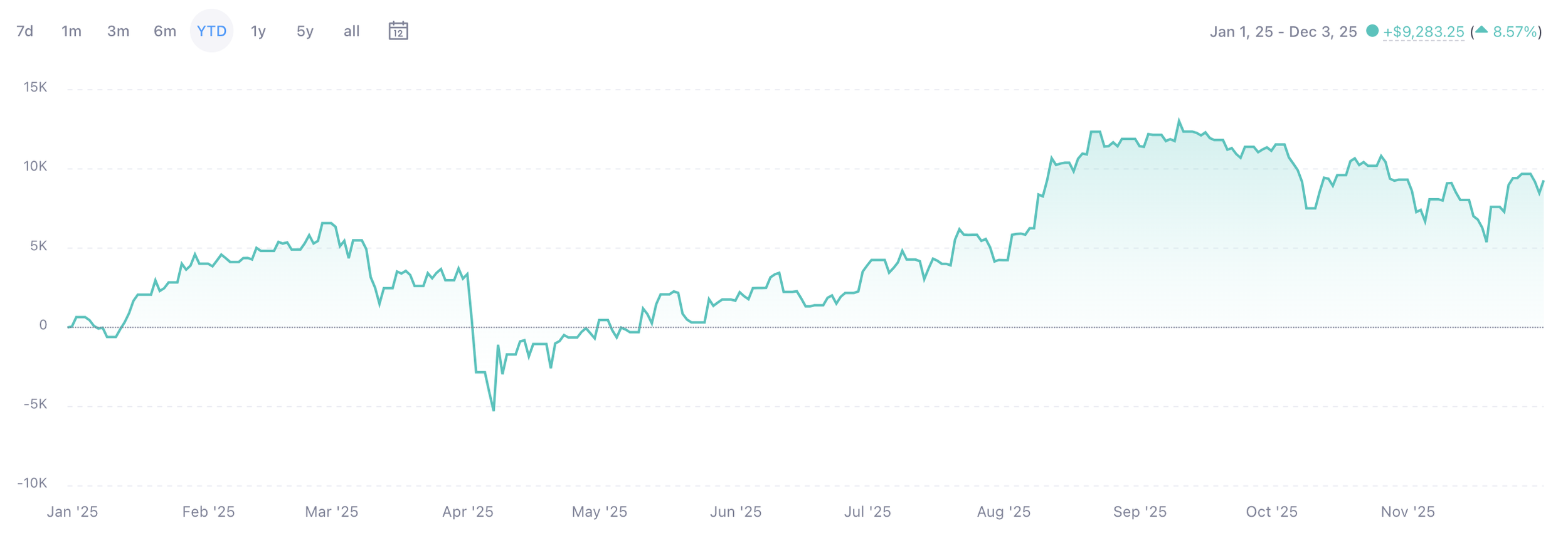
See my full portfolio with all of my holdings, trades, and dividends on Snowball Analytics! Plus, use code "rynewilliams" at checkout to get 10% off your subscription.
ICYMI 🎥
Most Investors Own Too Many Stocks — Here’s Why
In this episode of The Deep End, we get into a topic a lot of people don’t think about until it’s too late: owning too many stocks.
CAREFULLY CURATED 🔍
📺 Measure What Matters - This video from Marc Beavis explains why your returns don’t need to match the S&P, and why that mindset might actually be hurting you. This was honestly one of the most important videos I've watched this year.
🎧 The Witch of Wall Street - I finished reading a biography on Hetty Green, AKA the Witch of Wall Street, and this was a great podcast on how she built a massive fortune by staying liquid, thinking for herself, and ignoring the noise.
📚 Breaking the Mold - Every major innovation begins in what Andrew Montgomery calls a “gray area.” Railroads, credit cards, the internet — they all operated outside the old rules until society decided to either rewrite them or live with the consequences. Montgomery argues that artificial intelligence is the latest innovation to follow that same path.
SINCE YOU ASKED 💬
"Can you have a successful portfolio with just dividend growth stocks, or do you need high-yield to feed into it a little bit?"
- Shane | YouTube
So for starters, while any company that raises its dividend is technically a dividend growth stock, I personally think of dividend growth stocks as companies with lower starting yields (usually in the 1–3% range) that are growing their dividends at a pretty high rate (around 8% a year or more).
Using that distinction, I absolutely think you can build a successful dividend portfolio with just dividend growth stocks. In fact, I think those are some of the best kinds of companies you can own.
Because a dividend comes out of free cash flow, the only way a company can afford to pay and grow its dividend is if its free cash flow is also growing. And for the free cash flow to grow over long periods of time, the business has to grow its sales and net income.
To me, those characteristics should be non-negotiable. After all, why would you want to invest in a company that’s losing customers or shrinking its profits?
Plus, a company’s share price ultimately follows its financial growth. So if it’s consistently growing sales, earnings, and free cash flow — which, once again, leads to dividend growth — the share price will eventually follow.
Otherwise, if the share price stayed flat while the dividend per share kept growing, the yield would shoot higher, causing investors to pile in for the higher yield, and that new demand would drive the price up anyway.
With all of that said, you could actually make the argument that a company's share price follows its dividend growth.
Have a question? Ask me here to see it featured in an upcoming newsletter.