My Top Dividend Stock To Buy In February
Disclaimer: This page contains some affiliate links that might just lead you to the promised land of awesomeness (or at least some cool products). I may receive commissions for purchases made through links in this post.
As a die-hard dividend investor, there are few things I love more than high-quality, cash-flowing businesses that temporarily fall out of favor. And right now, I think one of the best examples of that is Salesforce (CRM), which is my top dividend stock to buy in February (you can see some of my other top stock picks for the month here).
Salesforce is one of those companies almost everyone has heard of, even if they don’t use it themselves. As a customer relationship management (CRM) platform, it sits at the center of how businesses manage their sales pipelines, customer data, marketing efforts, and other operational data.
Source: Investor Presentation
For many companies, Salesforce is effectively the neural network of how their organization operates day to day. And that’s important because it makes Salesforce an incredibly sticky platform — and one that’s getting stickier by the day.
Once a business builds its workflows around Salesforce, switching to a competitor becomes a massive headache. And the longer you’ve used the platform — and the more data you’ve gathered inside it — the more difficult it becomes to switch.
With that said, despite all the good things going for the company, the share price has been hit pretty hard. Over the past month, the stock is down more than 14%, and over the past year, it’s down about 36%.
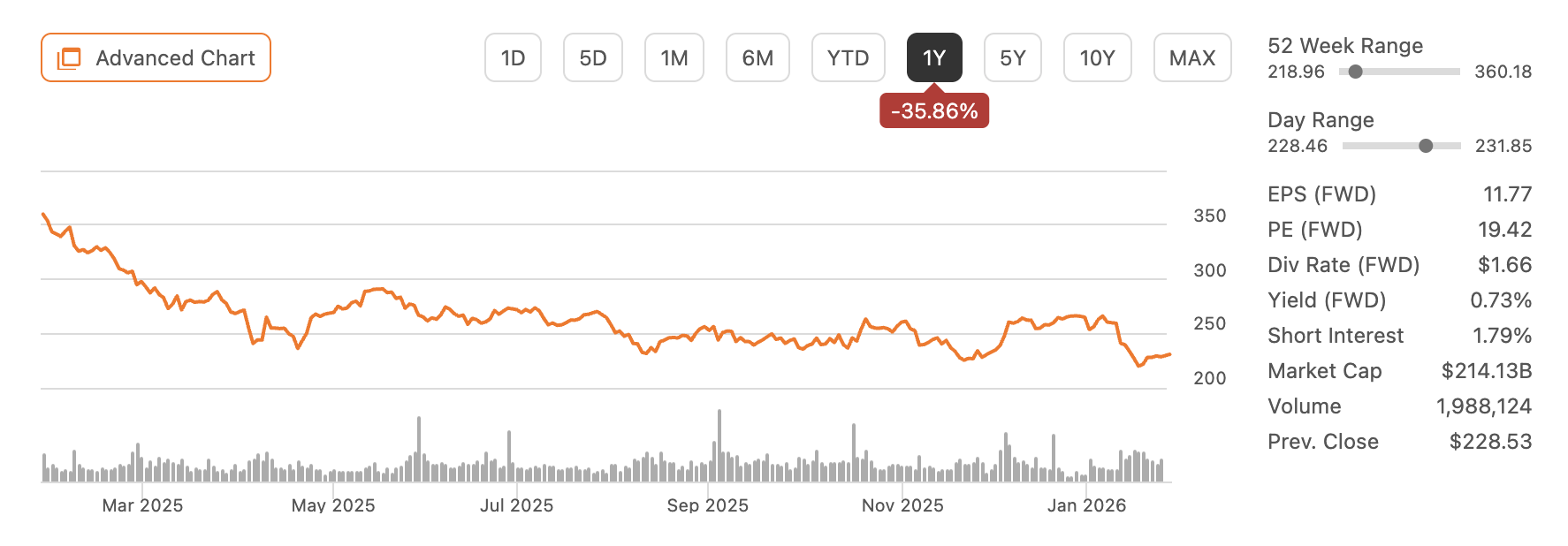
Source: Seeking Alpha
That kind of volatility usually indicates something bad is happening within the business, which naturally raises the question: if the business is still strong, why is the stock down?
A big part of the answer has very little to do with Salesforce specifically. Financially, the business is still growing like a weed, as can be seen below.
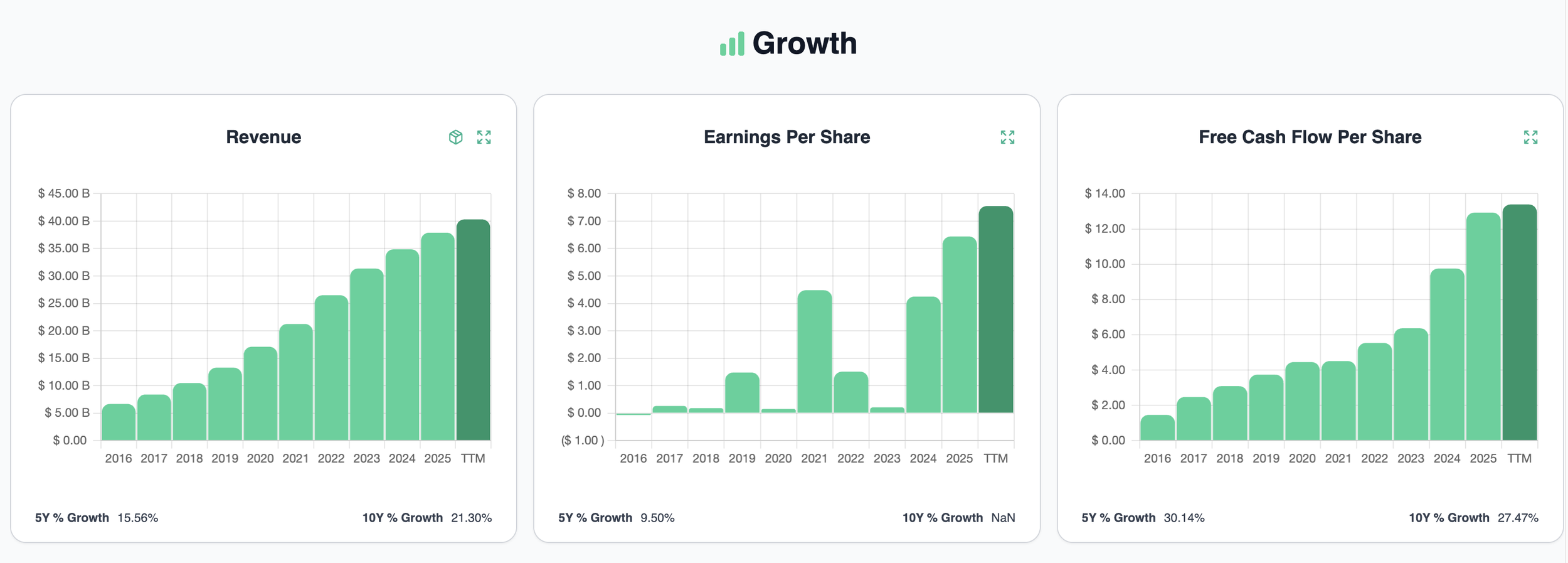
Source: Snapstock
Instead, it ties back to what’s been happening across the broader software space.
There’s been a lot of uncertainty around artificial intelligence and what it could mean for traditional software businesses. As AI tools become more capable — and cheaper to build — investors are questioning whether traditional software platforms will face more competition and obsolescence risk over time.
It’s a valid concern, and one that has led to a selloff across the entire space, affecting not just Salesforce, but other high-quality software names like Intuit (INTU) and Adobe (ADBE) as well.
The irony is that many of these businesses, Salesforce included, are actively integrating AI into their products. And what I think the market is missing is how Salesforce is actually approaching AI.
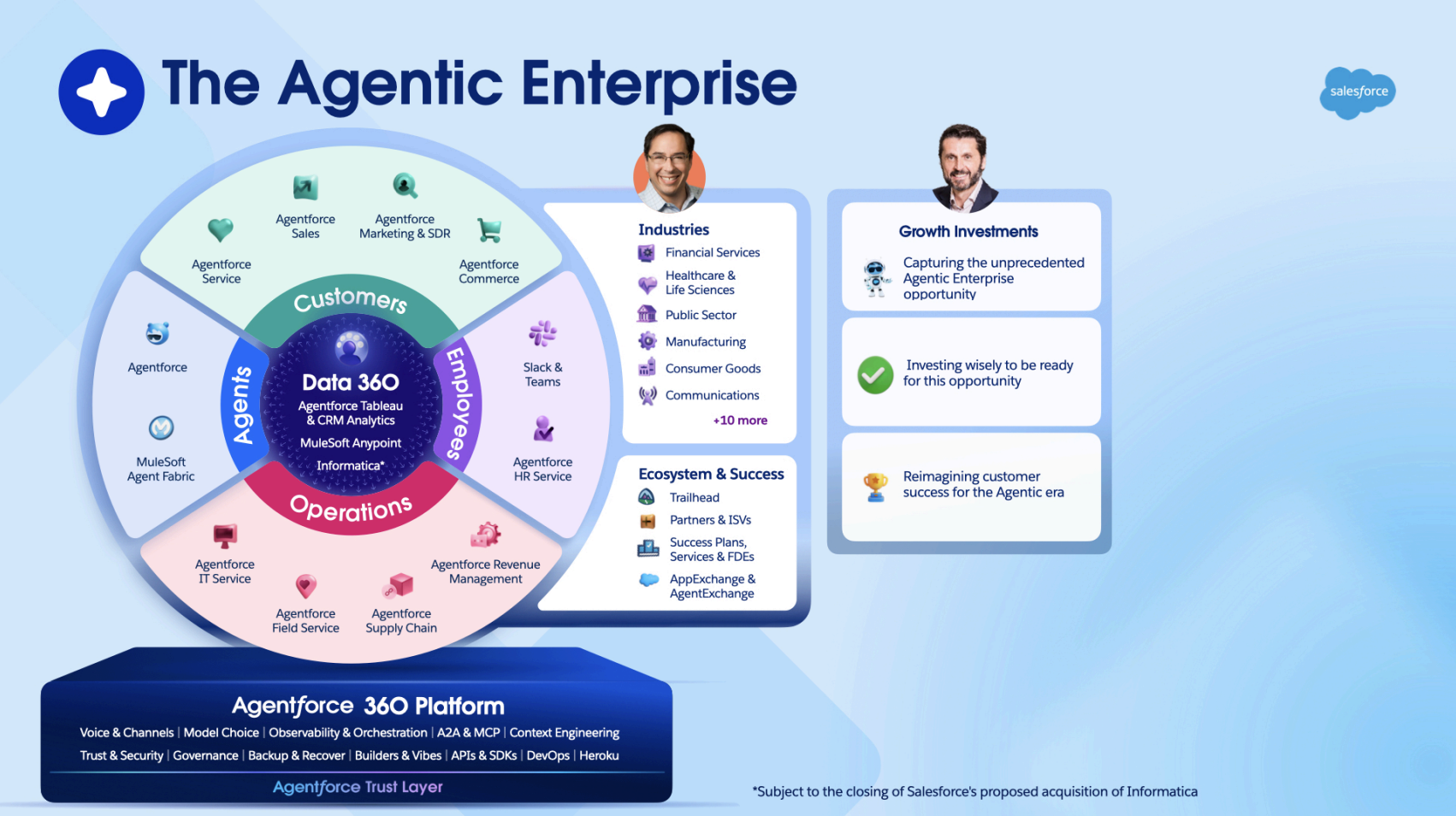
Through its Agentforce initiative, Salesforce is rolling out a full suite of AI agents, which are essentially digital employees that operate directly inside a company’s Salesforce platform and handle real work like customer support, sales workflows, and a wide range of other tasks.
Why this matters is that once businesses start relying on these digital employees that fully understand and operate within the context of a company’s customer data, Salesforce becomes even harder to replace than it already was.
Additionally, if everything works as it should, these AI agents should help the company improve in the areas where they’re deployed. Customer support should be resolved faster and more accurately, marketing efforts should see higher conversion rates, and customer behavior should be better understood. Over time, that should lead to greater efficiency and growth across the business.
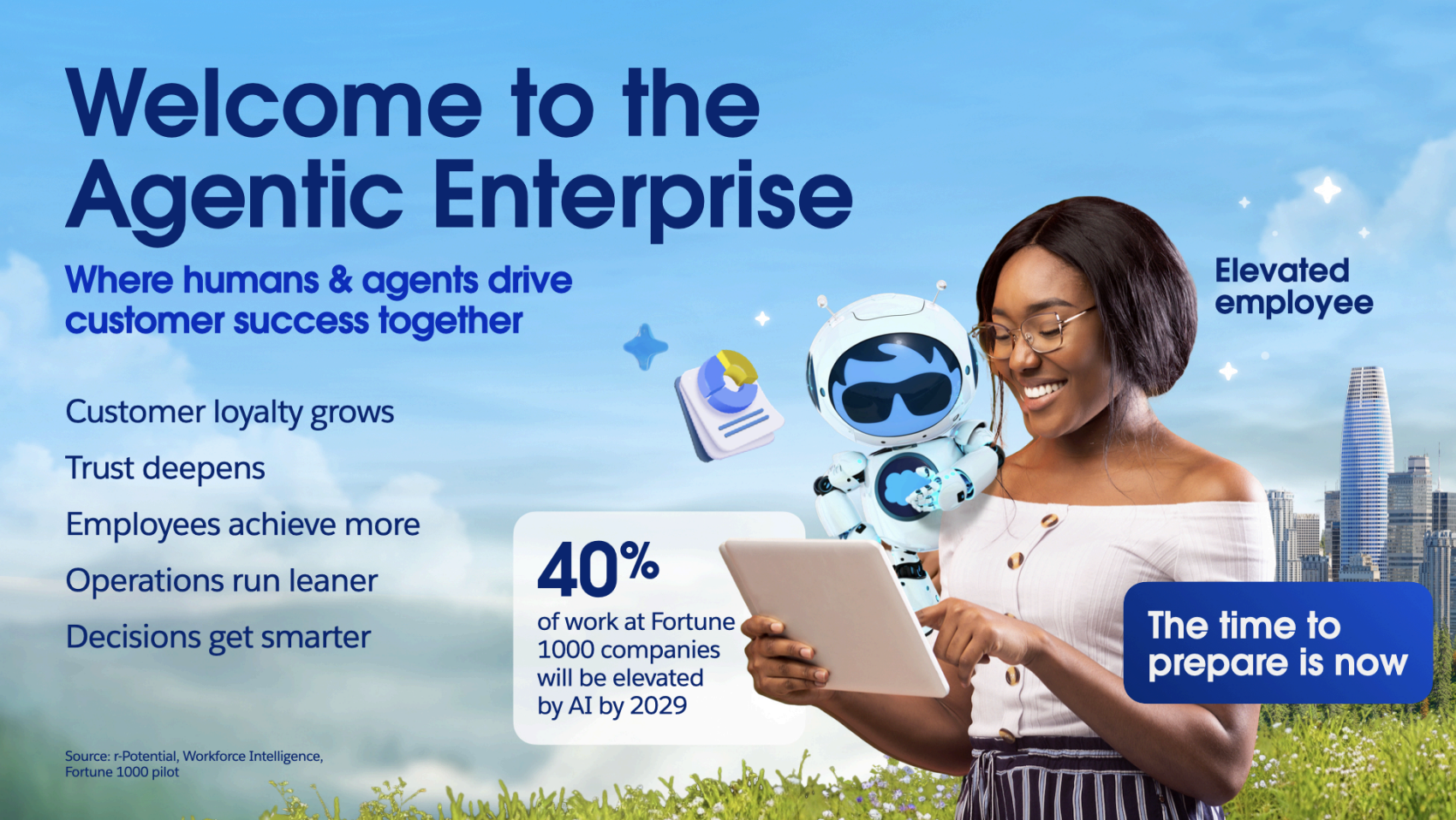
Source: Investor Presentation
So that’s the draw to Salesforce. And while it sounds good, the story is still playing out.
In the meantime, markets don’t love uncertainty. And until there’s more clarity around how AI actually ends up impacting these businesses, even these AI-integrated platforms are getting caught in the crossfire.
But from an investor’s perspective, that’s exactly what creates opportunity.
With that said, Salesforce isn’t the only good buying opportunity on the market right now. There are quite a few others worth paying attention to — and I want to hear from you: which discounted stocks do you have your eye on as we fly into February? Write to me here and let me know.
Dividend Investing Democratized
Join thousands of savvy investors in the pursuit of early retirement. Get Retire With Ryne delivered straight to your inbox every week as you build your perpetually growing, cash-flowing dividend stock portfolio.

I use Seeking Alpha every single day, and have done so for years now. It's my go-to website for everything related to stock research, and it's been essential in helping me become a better investor.
Whether I'm looking up dividend stats, reading the news, listening to earnings calls, or just want to find out what others are saying about a particular stock, Seeking Alpha has it all (for free), and the Premium version is even better.
The Premium version gives you unlimited access to Seeking Alpha's library of articles, personalized portfolio tracking tools, and a ton of other essential features for the dedicated dividend investor. You can see the full list of Premium features here.
Right now, Seeking Alpha is offering a 7-Day FREE Trial of their Premium platform so you can try it out risk-free. The best part is, if you end up loving it (which if you're like me, you definitely will), you'll automatically get $30 OFF of your annual subscription.
It's normally $299 for the year, but with the discount it comes out to $269. I've been using it for years, and have definitely found it to be worth the money.
If nothing else, it's at least worth checking out the 7-Day FREE Trial.
IN MY PORTFOLIO 📈
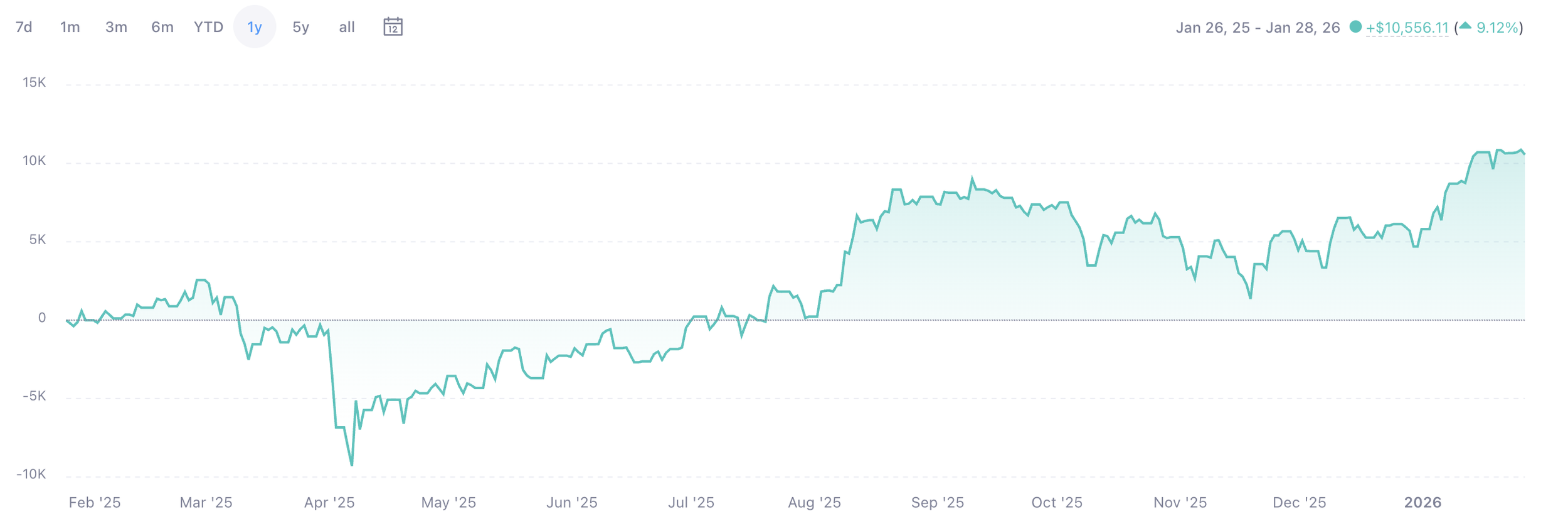
See my full portfolio with all of my holdings, trades, and dividends on Snowball Analytics! Plus, use code "rynewilliams" at checkout to get 10% off your subscription.
ICYMI 🎥
The Biggest Investing Mistake Everyone Makes (But Doesn’t Admit)
In this episode of The Deep End, we’re joined by our good friend Russ Knopf for a wide-ranging conversation about something most investors struggle with but rarely admit: learning how to actually think for yourself.
CAREFULLY CURATED 🔍
📺 Sleeping Giant - A great conversation with SCHD Stan on the Dapper Dividends channel, breaking down why SCHD’s recent struggles may be more noise than signal.
🎧 Psycho-Logic - A deep dive with Rory Sutherland (author of the book Alchemy, which I highly recommend) on why human psychology beats spreadsheets, why efficiency can actually destroy value, and how our human psycho-logic drives decision-making in unexpected ways.
📚 Quality Endures - Terry Smith lays out Fundsmith’s 2025 performance and talks about why long-term discipline matters even when benchmarks soar.
SINCE YOU ASKED 💬
"With 10–15 years until retirement, would you personally lean more toward individual stocks (your style), or a mostly ETF-based Roth/401(k) portfolio with a handful of individual stocks mixed in?"
- Eric | YouTube
This is a great question. And honestly, I’m not sure the time horizon matters all that much here. I don’t think having 10–15 years until retirement should be the deciding factor on its own.
Instead, I think the real question is how hands-on you want to be with your portfolio. Choosing between individual stocks and ETFs has more to do with your level of interest and how much time you want to commit than it does with how many years you have until retirement.
If you enjoy researching businesses and keeping up with them over time — and you actually want to do that work — then building a portfolio of individual stocks can make a lot of sense.
But if you’d rather your portfolio quietly grow in the background without much effort, ETFs are hard to beat. They let you build wealth without really having to lift a finger.
So more than anything, I think it comes down to which camp you fall into. And as you hinted at in your question, there’s absolutely room for both.
A portfolio that’s mostly ETFs, with a handful of individual stocks mixed in, strikes a great balance and offers the best of both worlds. In reality, that’s probably where most investors end up anyway.
Have a question? Ask me here to see it featured in an upcoming newsletter.