Disclaimer: This page contains some affiliate links that might just lead you to the promised land of awesomeness (or at least some cool products). I may receive commissions for purchases made through links in this post.
I’m sure you already know this, but SCHD has been having one heck of a year.
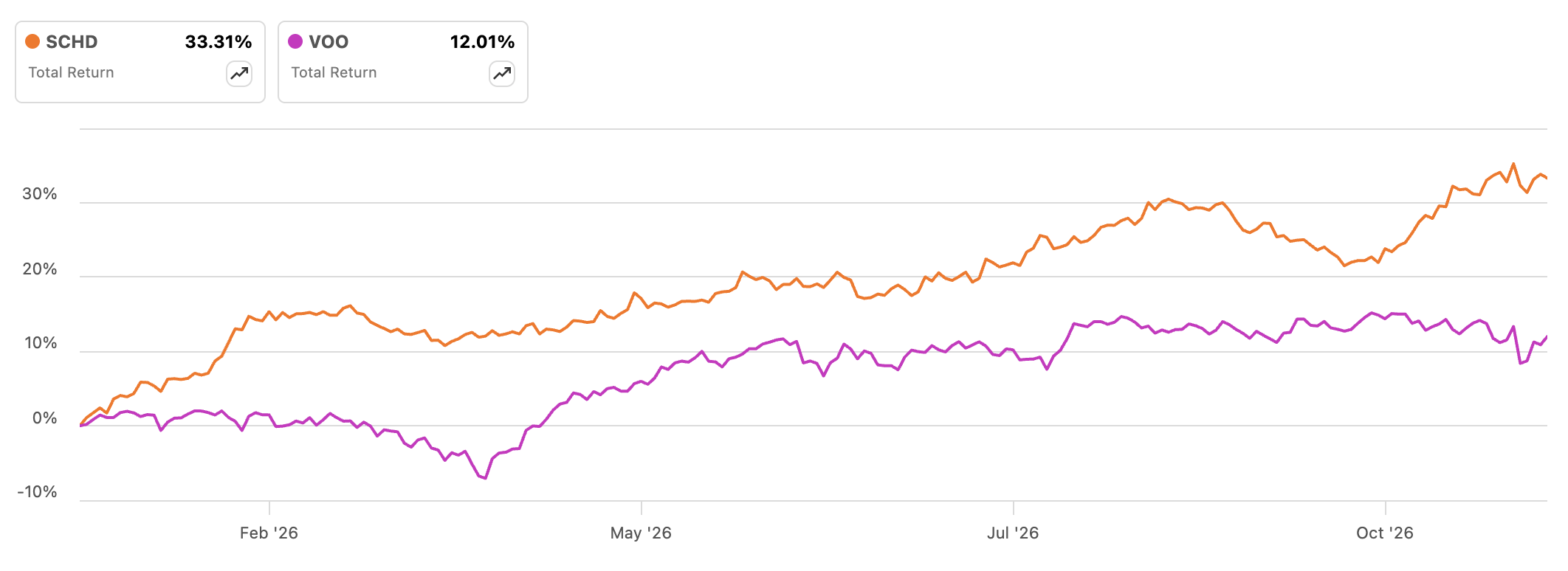
Source: Seeking Alpha
So far in 2026, the “Holy Grail” of dividend ETFs has delivered a total return of more than 33%, compared to about 12% for the S&P 500.
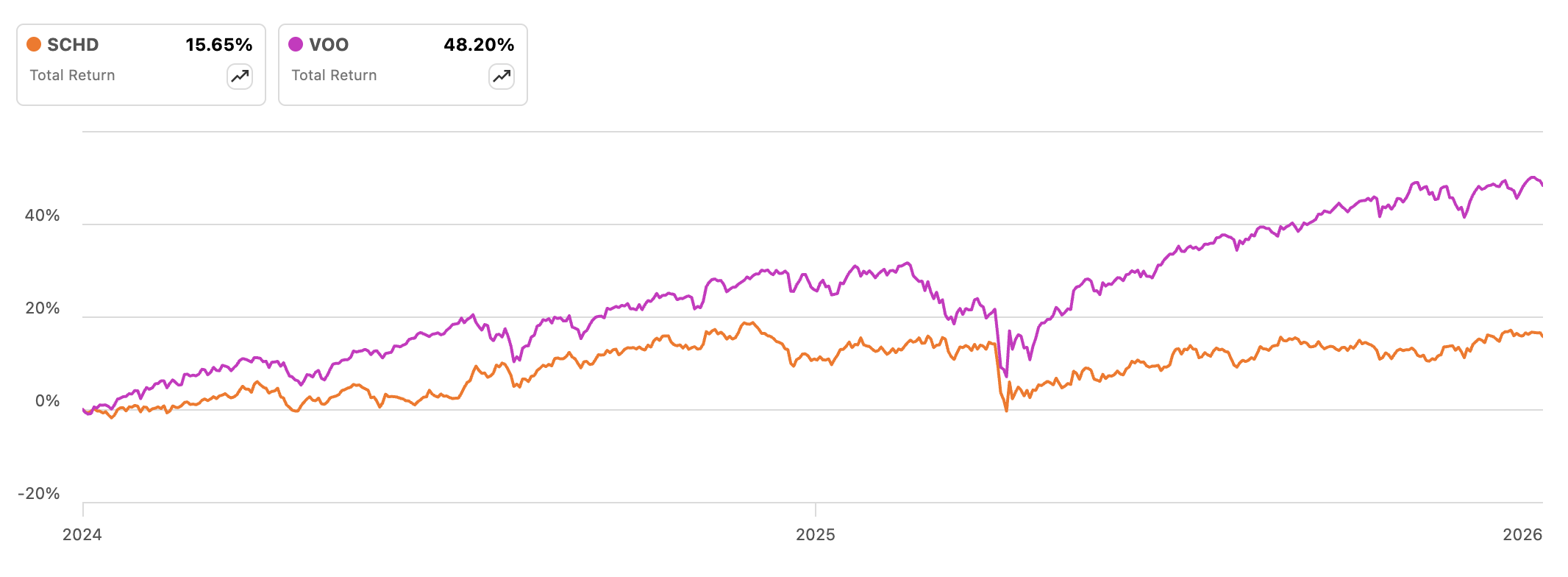
What's interesting about this is that just a year or two ago, investors were having a very different conversation about SCHD.
Source: Seeking Alpha
Throughout 2024 and 2025, the fund fell behind the broader market by no small margin, and plenty of investors were becoming convinced its best days were behind it. Now that SCHD has come back with a vengeance, though, the conversation has changed.
Instead of worrying because SCHD's share price wasn't going anywhere, investors are now worried because it's gone up so much, which raises an interesting question: With SCHD sitting at all-time highs, is it too late to buy?
Personally, I've been investing in SCHD for almost five years now. I started buying shares in my Roth IRA back in January 2022, and I've steadily been adding to my position every single week ever since.
Despite how much the fund has gone up this year, I have absolutely no plans to stop. And there are a few reasons why.
For starters, I think it's important to remember that different types of investments fall in and out of favor all the time. While the broader market was being driven higher by tech stocks throughout 2024 and 2025 (and still is today), SCHD was getting left behind.
But this year, investors seem to be showing renewed interest in the more traditional, value-oriented, cash-flowing businesses that make up a large portion of SCHD's portfolio. Specifically, we can look to the healthcare and energy sectors, which make up a combined 35% of the fund.
Looking at SCHD’s performance this year reminds me of something Bob Dylan once sang: “For the loser now will be later to win. For the times they are a-changin’.” And I think that’s exactly what’s going on with SCHD this year. Times are changing, and it’s just its time.
If there's one thing we can learn from SCHD's performance over the past few years, it's that just because an investment goes through a period of underperformance doesn't necessarily mean there's something wrong with it. Sometimes, you just have to be patient (go figure).
In SCHD's case, I never saw a reason to believe its underlying investment methodology had somehow stopped making sense. The fund invests in 100 dividend-paying companies chosen based on their financial strength, dividend history, and other fundamental characteristics.
And on the income side, SCHD offers what I think is one of the best combinations of dividend yield (3% at the time of writing) and dividend growth (9.2% average dividend growth over the past five years) among ETFs.

Source: Snowball Analytics
Today, I own just over 620 shares of SCHD, which generates about $650 per year in dividend income. And as I continue working toward my ultimate goal of eventually living off dividends, I expect SCHD will play an important role in getting me (and keeping me) there.
With that said, as happy as I am to see SCHD performing so well, there's actually something very bittersweet about watching its share price reach new all-time highs.
I’ve written about this a lot, so I apologize if you’ve read this from me before. But as someone who's still actively accumulating shares — and probably always will be — I actually benefit from lower share prices. So do you.
After all, the cheaper you can buy shares, the more shares you can purchase with every dollar you invest, and the more dividend income those dollars will generate.
While it feels good to see my investments becoming more valuable — and do so at a pretty rapid rate — every dollar invested today buys a little less dividend income than it would have a year ago.
But does that mean SCHD is too expensive to buy today?
Well, I think that's difficult to say for sure. I certainly wouldn't argue that SCHD is at the most attractive share price.
However, I approach buying an ETF like SCHD a little differently than I approach buying individual stocks. When buying individual companies, valuation is something I try to be mindful of (not always successfully). And if I think a stock is too expensive, I'm perfectly fine waiting for a better opportunity.
With SCHD, I'm buying a collection of 100 different businesses, all trading at different valuations. Rather than trying to determine whether the entire fund is attractively valued every time I invest, I'd rather just consistently buy shares on a regular basis — a time in the market vs. timing the market sort of thing.
That's exactly what I've been doing for nearly five years now. Sometimes I'm buying shares at higher prices like this year, sometimes at lower prices like the past couple of years, and over time, my purchase prices average out.
In a nutshell, I don't think SCHD reaching all-time highs means investors have somehow missed the boat. In my opinion, what matters far more than buying at the lowest possible price is having an investment strategy that you don't overcomplicate and can actually stick with for the long run.
That's been my approach with SCHD. And for the foreseeable future, I have no plans to change that.
With that said, I’d love to hear from you: How many shares of SCHD do you have in your portfolio? Reply to this email, or write to me here and let me know.
Dividend Investing Democratized
Join thousands of savvy investors in the pursuit of early retirement. Get Retire With Ryne delivered straight to your inbox every week as you build your perpetually growing, cash-flowing dividend stock portfolio.
IN MY PORTFOLIO 📈
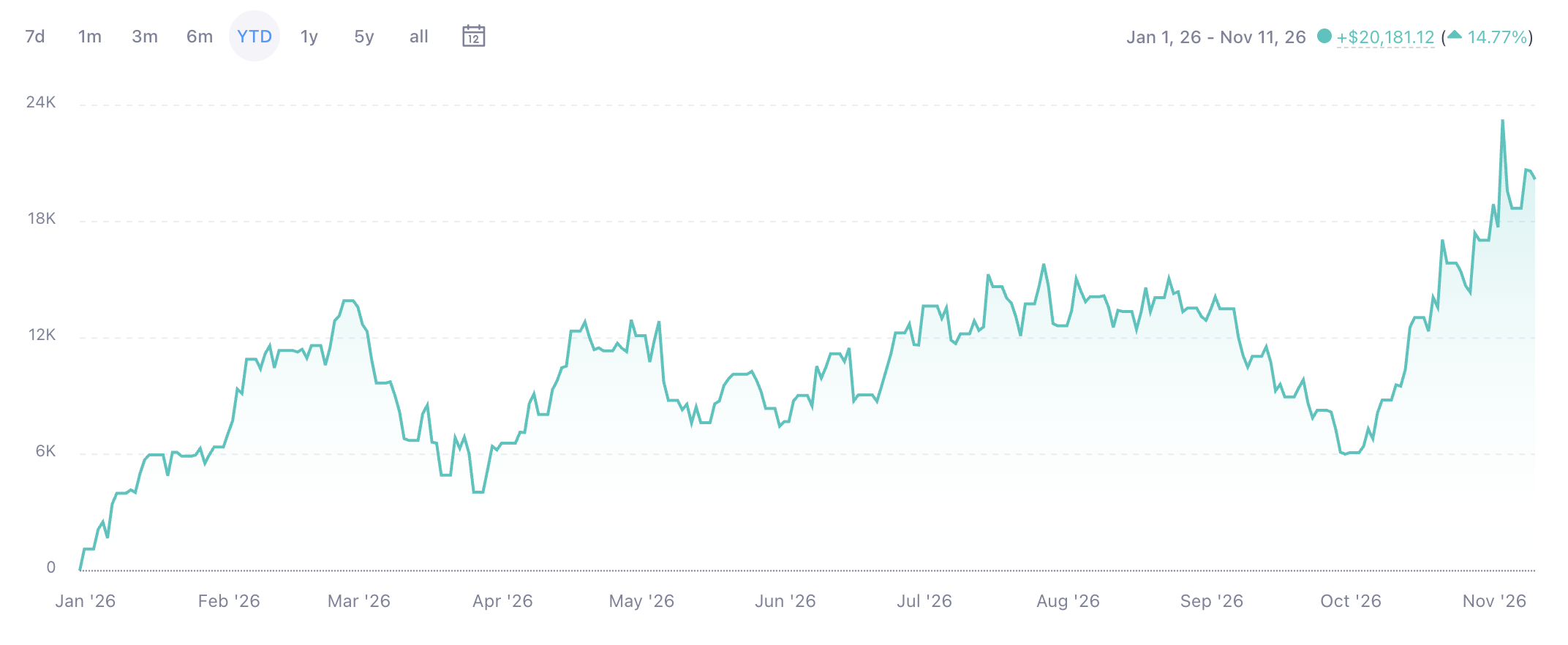
See my full portfolio with all of my holdings, trades, and dividends on Snowball Analytics! Plus, use code "rynewilliams" at checkout to get 10% off your subscription.
ICYMI 🎥
October was my best month of performance all year. In this month's portfolio update, I'll show you all of my buys, my best and worst performers for the month, and what my plans are here in November.
CAREFULLY CURATED 🔍
📺 The House Wins - VICI Properties has been getting hammered this year, but Brad Thomas thinks Wall Street has become far too pessimistic.
🎧 Less Screen Time - Checking your portfolio seventeen times a day isn't making you a better investor. This episode of the Investing For Beginners podcast explains why the best way to measure your investing success has very little to do with what your stocks did today.
📚 Beyond the Chowder Rule - The Chowder Rule can help you identify interesting dividend stocks, but it can't tell you whether those dividends are actually sustainable. Dave Ahern explains how to use it, where it falls short, and why a little fundamental analysis is still necessary.
SINCE YOU ASKED 💬
"I have a fun question: How would you manage a portfolio worth over $1 million?"
- Lawtv13 | YouTube
This is a great question! I actually think my approach would be pretty similar to what I'm doing today, just with a few adjustments to account for the (much) larger portfolio value.
For starters, I don't think my overall investing strategy would change all that much. I'd still be focused on owning fundamentally strong, dividend-paying businesses, and I'd still like to have a good balance between high-yielders, dividend growth stocks, and the steady stalwarts in between.
With that said, I do think I'd become more diversified as the portfolio grows, and I could see myself increasing my exposure to ETFs. This is something I'm actually working on right now.
Currently, SCHD and VOO make up about 24% of my combined taxable brokerage and Roth IRA, and I've been working to gradually increase that amount over the past couple of years. In fact, if we include my wife's taxable account, our total ETF exposure is closer to 30%.
Long term, I wouldn't mind having something closer to a 50/50 split between ETFs and individual stocks. I like the idea of having half of the portfolio invested in passive funds that I can just continue dollar-cost averaging into, while the other half is made up of individual businesses that I've researched and have a certain affinity for.
I'd probably also increase the number of individual stocks I own. At the moment, I have 19 individual positions, and I'm pretty happy with that number based on my portfolio's current value. Adding another 10 or 20 companies to the collection would feel like overkill right now.
But I do think it makes sense to become a little more defensive and spread out as your portfolio gets larger, especially as you get closer to actually using that income. After all, if you're relying on your dividends to pay your bills and keep you from having to go back to work, protecting that income stream becomes all the more important.
Because of that, I could see myself eventually owning 30 or 35 individual stocks. Maybe even 40, although that sounds like quite a lot.
So, I guess that's what my million-dollar portfolio would look like. More or less a continuation of what I've already built, just with greater exposure to ETFs, a larger collection of individual stocks, and a greater emphasis on protecting the income I'm generating.
Of course, we'll see how my thoughts on that change between now and then. But as things stand today, that's about how I'd approach it.
Have a question? Ask me here to see it featured in an upcoming newsletter.
LAST WORD 👋
I love hearing from you all, and I'm always looking for feedback. How am I doing with the newsletter? Is there anything you'd like to see more or less of? Which aspects of the newsletter do you enjoy the most?
Your insights on these matters are essential in making this newsletter the best it can be. If you want to help, take a moment to share your thoughts by completing this quick form. It'll take you less than 60 seconds - guaranteed.
Thanks in advance!