Disclaimer: This page contains some affiliate links that might just lead you to the promised land of awesomeness (or at least some cool products). I may receive commissions for purchases made through links in this post.
As opposed to the last three months, October was a pretty exciting month for my portfolio.
Not only did I recently reach a new dividend income milestone, which I wrote about in last week's newsletter, but my portfolio also officially crossed $150,000 in value.
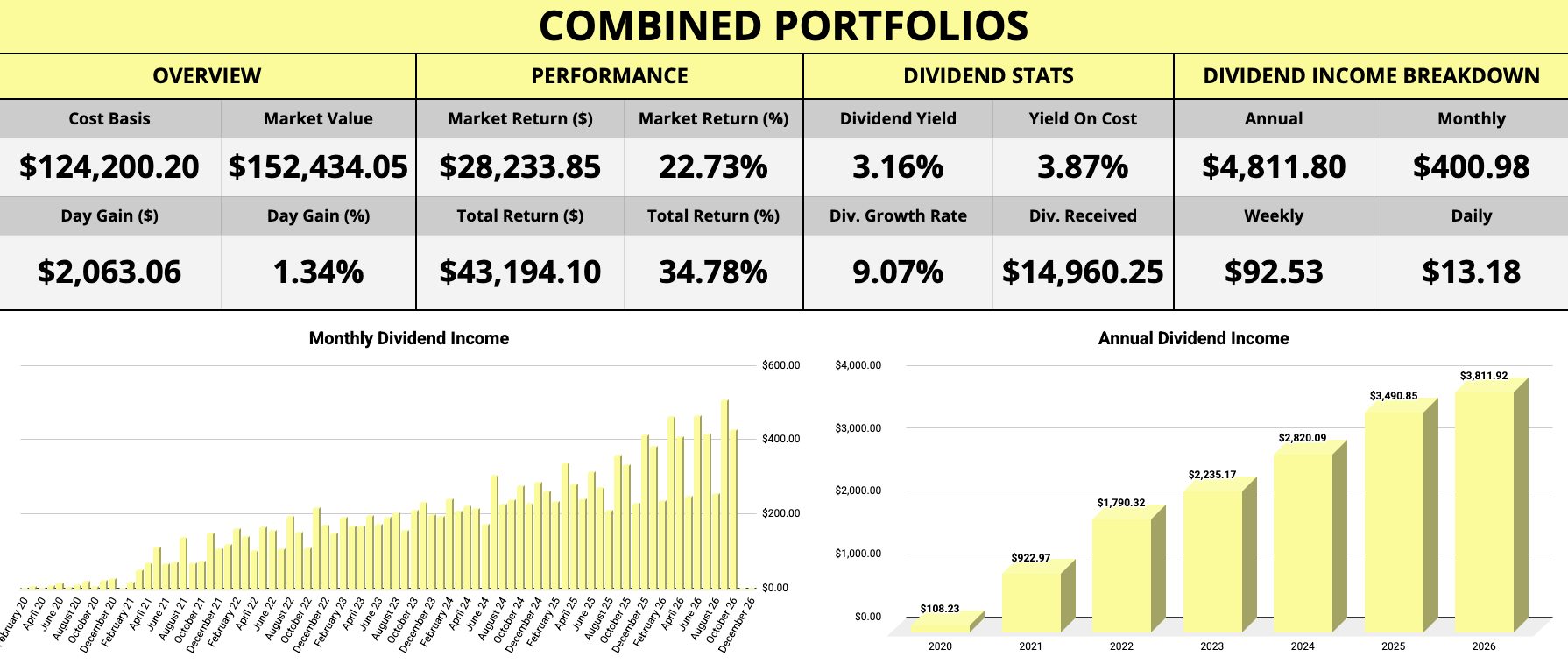
It's taken me six years of investing to get to this point. And looking back, it's been an incredible journey with so many valuable lessons learned along the way.
In celebration of reaching this milestone, I put together a list of 20 of the most important lessons I've learned over the past six years of dividend investing. I hope you enjoy reading it half as much as I enjoyed writing it!
1. Think In Decades, Not Months
I think this is one of the most important lessons to learn, but also one of the most difficult to actually practice.
With all the time we spend on social media and the internet, it's easier than ever to get caught up in the headlines, sensationalism, and other short-term noise that can distract us from the bigger, longer-term picture.
The market naturally has its ebbs and flows, sure. But through all of them, it's important to stay patient and consistent, especially when doing so feels the most difficult.
Rather than trying to time the market or worrying about things outside of your control, I think it's best to stay laser-focused on what you can control: how much you're contributing to your portfolio, how consistently you're investing, and having the patience to give compounding enough time to work.
If you can continue doing those things through all the ups and downs, I think you'll be just fine in the long run.
2. You Don't Need to Own Every Company
I'm a big advocate for diversification, but I do think there's a point where adding more holdings offers diminishing returns. After all, every new holding requires additional contribution dollars and attention, and there's only so much of both you can offer.
Plus, the more holdings you have, the more likely your returns will mirror those of the broader market. In that case, you might be better off just investing in a broad-based ETF.
Rather than constantly adding new stocks, even if they seem like great investments, I think it makes more sense to stick with a manageable collection of companies that you understand really well and can become more familiar with over time, instead of spreading yourself too thin.
There are tons of great companies out there, but sometimes the discipline to pass on a good investment opportunity is just as important as recognizing one in the first place.
3. Don't Chase Dividend Yield
This is a lesson that a lot of dividend investors, myself included, have to learn the hard way.
When you're first starting out, it's easy to get excited about getting dividend income, and that excitement can cause you to gravitate toward stocks with higher yields. After all, why settle for a 3% yield when you could get a 9% yield instead?
Higher yields aren't always better, though. Sometimes the businesses offering those yields come with underlying problems and/or dividends that aren't sustainable.
Of course, certain investments — like REITs, MLPs, and BDCs — naturally offer higher yields, and there's nothing inherently wrong with them. The important thing is to understand what you're investing in, whether or not the dividend is sustainable, and not to buy a stock just because it has a high dividend yield.
4. Don't Sell a Great Company Just to Buy Another One
I've made this mistake a handful of times over the years and have sold shares of great companies just to fund investments in other ones.
One example was selling out of Apple (AAPL) early on in my investing journey to buy Southern Company (SO), which increased my dividend income quite a bit considering the difference in their yields.
Southern Company turned out to be a great investment for me too, but if I'd held onto those Apple shares, it would've turned out to be my best investment of all time. At this point, I would have quadrupled my money.
The lesson here is that adding a new investment doesn't necessarily mean you need to sell something you already own to buy it, especially if the thing you'd be selling is another great business. If that's the case, sometimes the best thing you can do is be patient, hold on to it, and let it keep doing its thing.
(Note: I eventually bought back into Apple at a higher price, and still did very well with it.)
5. Judge Your Decisions by the Process, Not Just the Outcome
It's easy to judge the quality of our investment decisions by their outcomes, but that's not always the right way to look at things.
For example, you can buy a stock you know absolutely nothing about and make a ton of money on it, just as you can do all the research in the world on a great business and still see its share price decline.
A favorable outcome doesn't necessarily mean you made a good decision, though. And an unfavorable outcome doesn't necessarily mean you made a bad one.
What matters is the reasoning behind your decisions, not just whether you made or lost money.
6. Know What You're Buying and Why You're Buying It
One of the great things about the internet is the abundance of information at our fingertips, and all the investment ideas that come from that. Even today, I'm constantly finding out about great new stocks, and a lot of that comes from people sharing them in our little community here.
With that said, it's important to remember that these are just ideas, and just because someone else is buying a stock — or just because I'm buying a stock — doesn't necessarily mean you should too.
In other words, there's a big difference between finding out about an investment idea and deciding to act on it. Before adding anything to your portfolio, it's important to do your own research, understand the underlying business, and know why you believe it's a good investment.
I know that the whole “do your own research” and “not financial advice” stuff is cliché at this point in the finance and investing corner of the internet. But there's a good reason why it keeps being said.
7. Start Where You Are, With What You Have
One of the most common things I hear from people who aren’t investing is that they'll start investing when they have more money, or when the market pulls back, or something like that.
But the truth is, there's never going to be a perfect time to start. And these days, the barriers to entry have practically disappeared. You can invest a dollar at a time if that's really all you can offer (it's still better than nothing!).
Especially when you're first starting out, building the habit of consistently investing is much more important than the amount you're contributing anyway.
You can always increase your contributions as time goes on, but establishing that habit early on and sticking with it is what really matters. And for a lot of people, that's the most difficult part of getting started.
With that said, I’ve never met anyone who regrets starting to invest. It’s not always easy, but it’s always worth it.
8. Dividend Growth Isn’t Guaranteed
There's something reassuring about investing in a company with an extensive dividend growth history. And I think there's something to be said for businesses that have continued increasing their dividends through recessions, market crashes, pandemics, and other difficult periods.
It's one of the reasons investors are drawn to Dividend Aristocrats and Dividend Kings, and I don’t blame them.
It's important to remember, though, that dividends are never guaranteed, regardless of how long a company's growth streak is. Even businesses with decades of dividend growth can eventually reduce or eliminate their payouts, as we've seen with companies like 3M (MMM), VF Corporation (VFC), and Leggett & Platt (LEG).
9. Not Every Dip Is Worth Buying
There's a lot to be said for buying stocks when their share prices have gone down. After all, why wouldn't you want to buy something for a lower price if you have the opportunity? Everyone loves a good sale.
Before you buy the dip, though, it's important to understand why a stock has dropped rather than automatically diving in to buy shares.
Sometimes share prices drop because of short-term noise or other things that don't really matter. But other times, there are legitimate reasons for the decline that could have a lasting impact on the business and its long-term financial health.
Before buying shares, you'll just want to know what's what.
10. Buy and Hold, Don’t Buy and Forget
One of the benefits of long-term investing is that much of the research is front-loaded before you actually buy a stock. But something I've learned over the years is that you usually come to understand a business even better after you own it, and that understanding deepens the longer you stay invested.
It's a lot like being in a relationship, actually. The longer you're with someone, the more you come to know them, and I think the same is true with businesses.
Companies are constantly changing and evolving, and just because you plan to hold a stock forever doesn't mean you can buy it, put it on a shelf, and forget about it. Owning individual companies comes with an ongoing responsibility to keep up with their happenings and stay in the loop.
11. Learn to Distinguish Between What Matters and What Doesn’t
As we've established, there's more content about investing available today than ever before.
And while I think it's great that more people are getting interested in this stuff, more voices and opinions also mean more noise. This is especially true on social media, where people are competing for attention and sensationalism is incentivized.
As you gain experience, though, I think you naturally become better at separating what matters from what doesn't. And whenever you see a dramatic headline, a seemingly scary piece of news, or a severe reaction in a stock's share price, ask yourself: Will this actually matter for the business five or ten years from now?
If the answer is no, it's probably not worth worrying about.
12. Enjoy the Process, Not Just the Destination
This is an important lesson not just in investing, but in life as a whole.
I understand that for most of us, the ultimate goal is financial freedom, and I'm working toward that same goal myself. But as important as reaching that destination is, I think it's equally important to enjoy the process of getting there.
Looking back on my own journey, I've learned so much over the past six years, developed invaluable skills, and become part of an incredible community of people that I otherwise never would have met.
While reaching financial freedom will certainly be glorious, I've already gotten so much out of just being on the path toward it. And I think there's something to be said for finding joy in the “getting there,” too.
13. Tax-Advantaged Accounts Are Still Important Even If You Want to Retire Early
When I first started investing, I knew I wanted to retire early and begin living off my dividends, hopefully sometime in my mid-40s. Because of that, I initially overlooked tax-advantaged accounts like the Roth IRA, thinking I wouldn't have much use for them.
But something I eventually realized is that even if I do retire early, I'm still going to reach that traditional retirement age someday. And I would imagine that the 60-year-old version of myself would want as much tax-free gains and income as I can get my hands on.
At the end of the day, these different account types are just tools, and they each have their own sets of pros and cons. It's important to choose the best tools for the job, but don't forget to consider your future self either, no matter how far away that version of yourself seems.
14. You Don’t Need Exposure to Every Sector
In the same way that I like collecting watches, I've always thought of myself as a collector of businesses that, for one reason or another, resonate with me. And something I've learned over the years is that you're not necessarily going to find companies you like or understand in every sector.
For example, I currently don't own any companies in the utilities or materials sectors, and I'm perfectly fine with that. I don't think you should buy stocks just to fill gaps in your portfolio or check certain boxes.
Instead, focus on your circle of competence, only invest in businesses you actually understand, and lean into your strengths rather than forcing yourself into unfamiliar territory.
15. Know Thyself
One of the most important things you can do as an investor is, like Socrates said, “Know thyself.”
What are your investment goals? How risk-averse are you? When do you plan to start pulling from your investments?
These are all questions you need to ask yourself. Don't worry if you don't have the answers at the start, though. I've come to find that you'll naturally develop a better understanding of the answers to these questions over time. And they'll likely change along the way as well.
The truth is, if you don't know what's important to you, there will be no shortage of people dying to tell you what you should be doing with your money and what should be important to you.
At the end of the day, though, your investing strategy needs to align with your personal situation, your goals, and your temperament. The best approach (the only one, really) is one that works for you and that you can comfortably maintain for a long period of time.
16. Yield Isn't Everything, but It Does Matter
As we've already discussed, you shouldn't buy a stock just because it has an attractive dividend yield. But that also doesn't mean that yield isn't important.
Different dividend stocks offer different profiles, from lower-yielding companies with higher dividend growth like Visa (V), to steady stalwarts like Procter & Gamble (PG) that fall somewhere in the middle, to higher-yielding investments like Altria Group (MO) that can offer more immediate income.
I think it’s sensible to have a healthy mix of these different types of dividend payers, but depending on your goals and where you are in your investing journey, it might make sense to lean more heavily toward one type over another.
Ultimately, it just comes back to building a portfolio that fits your personal situation. Once again, “Know thyself.”
17. Don’t Load the Boat Too Quickly
This is a lesson I've learned the hard way with investments like Zoetis (ZTS) and Watsco (WSO).
In both cases, I got excited about the businesses and built relatively large positions in a very short period of time, only to watch their share prices decline afterward in a big way. And while I still think they're great companies and I'm happy to own them, looking back, I wish I had been a little more patient in building out those positions.
In trying to heed this advice, I've taken a different approach with my newest position in Rollins (ROL). With this company, I started with a very small position and have gradually been adding shares over time. So far, this has been a much better approach.
Even though it's good to be excited about the companies you own, there's no rush to build out your positions. You're going to have a long, long time to do so.
Sometimes it's better to give yourself some breathing room to build slowly, especially if the share price declines and you get the opportunity to buy more at lower prices. You'll be glad you didn't load the boat all at once.
18. Even a Great Company Can Be a Bad Investment at the Wrong Price
Building on the previous lesson, another thing I've learned from my experiences with companies like Zoetis and Watsco is that even a great business can turn out to be a bad investment if you pay too much for it. I knew this beforehand, but apparently, I needed to be reminded the hard way.
It's easy to get excited about a high-quality company and convince yourself that it's worth paying a premium for. After all, nice things are worth paying more for. This isn't exclusive to stocks.
But the price you pay still matters, and even if a business continues growing its sales, earnings, and free cash flow, that doesn't necessarily mean its share price will follow right away. In fact, share prices rarely move in a straight line.
If investors, for one reason or another, become unwilling to pay the same valuation for the stock as they did in the past, the share price can decline despite the underlying business continuing to grow. It doesn't always seem fair or sensible, but the market doesn't always make sense.
19. The Best Way to Become a Better Investor Is by Actually Investing
There's really no substitute for actual experience. You can read all the investing books in the world — and I've certainly read my fair share (you can read all my book notes here) — but eventually you reach a point where you need to start putting that knowledge into practice.
It's only when you get some skin in the game that you really begin developing your own mental models and understanding what works for you.
In fact, most of the lessons I've shared here aren't necessarily things I've learned from reading books. They're things I've picked up through six years of actually being an investor, making decisions, learning from (plenty of) mistakes, and gaining experience along the way.
20. You Can Do Ordinary Things and Still Get Extraordinary Results
The fact of the matter is that building my portfolio to where it is today hasn't required me to do anything fancy. It's really just been about consistently contributing to my portfolio, avoiding catastrophic mistakes, and being patient enough to let time and compounding do their thing.
One of the most rewarding things I've experienced over the past six years — really over the past two, I'd say — is how the momentum has accelerated. It took me about 3.5 years to build my first $50,000, about two years to reach $100,000, and only about a year to get to $150,000 from there.
And that's one of the coolest things about investing. Over time, you really start to see the results of all those small, consistent actions — which is why it's so important to just start, no matter how much you have to contribute.
Like I said, you don't need to do anything fancy or get too cute with your investments. If you just stick to the basics, stay disciplined, and give it time, you'll be well on your way to building wealth.
Now, with all of that said, I want to hear from you: What are some of the most important lessons you've learned throughout your own investing journey? Write to me here and let me know.
Dividend Investing Democratized
Join thousands of savvy investors in the pursuit of early retirement. Get Retire With Ryne delivered straight to your inbox every week as you build your perpetually growing, cash-flowing dividend stock portfolio.