Socrates’ Advice For Building The Perfect Portfolio
Disclaimer: This page contains some affiliate links that might just lead you to the promised land of awesomeness (or at least some cool products). I may receive commissions for purchases made through links in this post.
Socrates was a pretty wise dude, and I think one of his most important sayings is also one of his shortest: “Know thyself.”
This is good advice for life in general — it’s important to know who you are and construct your life accordingly — but I think this is especially important when it comes to building your portfolio.
Over the years, I can’t tell you how many times I’ve been told that I shouldn’t be buying this stock, or that stock, or that I’m screwing up my financial future because I choose to only invest in dividend-paying companies.
I’ve been told that because I’m young, I need more “growth.” I’ve also been told the opposite: that I need more high-yielders to be a real dividend investor. And, of course, I’ve been told I should just sell everything, buy the S&P 500, and call it a day.
Some of that might be perfectly good advice for the right person, but the fact of the matter is that the way I choose to build my portfolio fits me, my temperament, and what I’m trying to accomplish. And at the end of the day, I think that’s what we should all be shooting for.
With that said, in order to build a portfolio that makes sense for you, you first have to heed the words of Socrates and know thyself.
You have to understand what your actual goals are, how much volatility you can stomach, what your time horizon looks like, and what’s important to you in an investment. Some of these things can only be found through experience, but the fact remains that the portfolio that makes sense for someone else might make absolutely no sense for you.
Someone who’s 65 years old, has been investing for decades, and is living off their portfolio probably has very different goals and priorities than someone who’s 25, newer to investing, and has another 40 years to invest.
Age is only one variable, though. Someone else might be perfectly calm, cool, and collected watching their portfolio drop 40%, while for you, that kind of volatility might cause your hair to completely fall out. Personally speaking, I would find that difficult to bear.
Even within dividend investing, there are a million different ways you can do this. Some investors are only after current income and are heavy in high-yield stocks. Others prioritize dividend growth and don’t mind lower starting yields. And some people, such as myself, like to have a mix of both.
At the end of the day, the “best” investing strategy on paper isn’t necessarily going to be the best investing strategy for you.
The best strategy is one that aligns with what you’re trying to accomplish and is something you can actually stick with for decades through all of the inevitable highs and lows. After all, no investing strategy will do you much good if you jump ship the moment things get tough.
Now, that doesn’t mean you should blindly stick with a strategy that consistently diminishes your wealth just because you enjoy it. We should all continue learning and improving as investors. After all, that’s part of the fun.
And the portfolio that fits you today might not be the same portfolio that fits you 20 years from now. As your life changes, your strategy will too.
There’s a big difference, though, between evolving your strategy based on your own needs and completely changing it because somebody else says you should. Everyone has a different method to the madness, and that’s what makes the world go round.
So what have you learned about yourself as an investor over the years?Write to me here and let me know.
Dividend Investing Democratized
Join thousands of savvy investors in the pursuit of early retirement. Get Retire With Ryne delivered straight to your inbox every week as you build your perpetually growing, cash-flowing dividend stock portfolio.
IN MY PORTFOLIO 📈
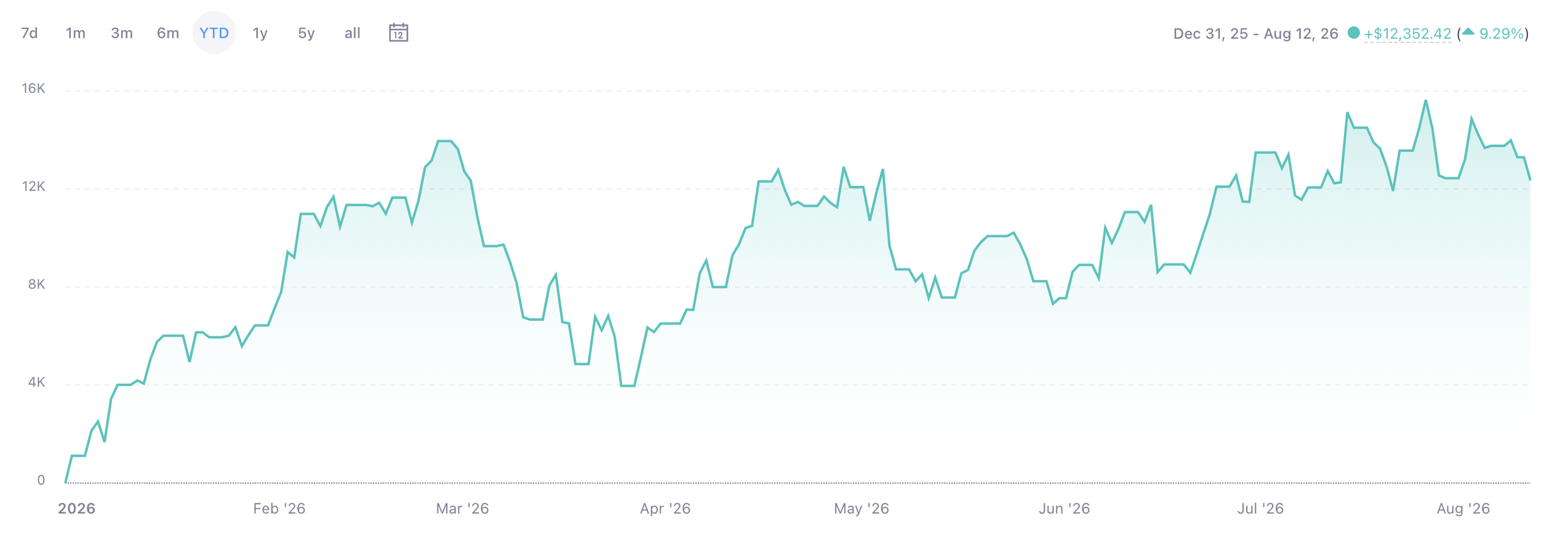
See my full portfolio with all of my holdings, trades, and dividends on Snowball Analytics! Plus, use code "rynewilliams" at checkout to get 10% off your subscription.
ICYMI 🎥
These three stocks look like prime dividend cut candidates. In fact, since releasing this video, one of them has already suspended its dividend entirely.
CAREFULLY CURATED 🔍
📺 Is VICI Mispriced? - My friend Eli from Dividendology just launched a new podcast called Mispriced, and he kicked things off with a great guest: Ed Pitoniak, CEO of VICI Properties.
🎧 Everybody Inherits Something - Bogumil Baranowski joins the Gravitas podcast to talk about why preserving wealth across generations has just as much to do (if not more) with family culture and values as it does with the money itself.
📚 Building A Blockbuster - Quartr takes a deep dive into the history of Take-Two Interactive (TTWO) and how it built an empire around franchises like Grand Theft Auto, Red Dead Redemption, and NBA 2K.
SINCE YOU ASKED 💬
"Two questions: It seems like Watsco (WSO) has missed earnings estimates fairly regularly. What specifically makes you believe it’s still a buy rather than a sign of shaky fundamentals? Also, I noticed that you’re substantially underweight the technology sector. Is there a specific reason behind that?"
- Andrei | YouTube
These are both great questions!
Regarding Watsco, I’m not all that concerned about them missing earnings estimates. I generally don’t think it’s anything to get worked up about if the events of the world don’t play out exactly the way analysts expect, even if it impacts the share price in the short term.
Analysts are fighting a bit of an uphill battle with WSO anyway since the company doesn’t provide quarterly earnings guidance. They always try to get some forward-looking information out of management on the quarterly earnings calls, but management is pretty stern in its aversion to offering any guidance, which I actually respect.
Don’t get me wrong, guidance can be helpful because it gives investors an idea of what to expect going forward. But the downside is that it can also create arbitrary short-term expectations that a company feels pressured to meet, even when those expectations aren’t necessarily realistic for the business.
In trying to live up to those expectations, management might be tempted to make decisions that make the numbers look good in the short term but ultimately hurt the company over the long term. So I’m glad Watsco chooses not to play that game at all and instead focuses on the long-term growth of the business.
More importantly, though, missing an analyst estimate isn’t necessarily the same thing as having shaky fundamentals. I’m much more concerned with how the underlying business is actually performing than whether it lived up to what analysts expected in a particular quarter.
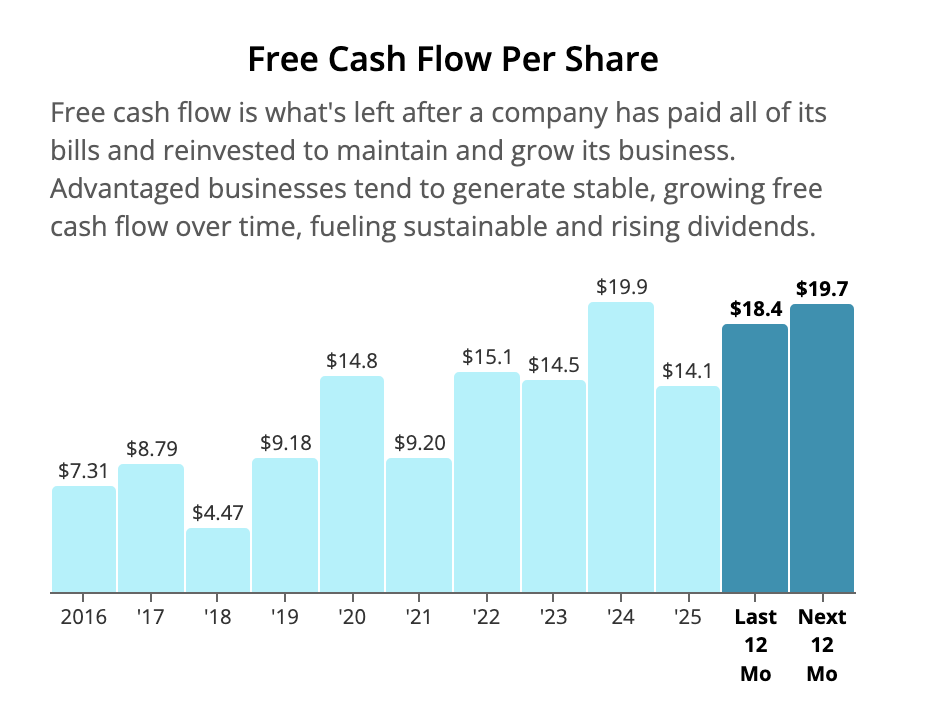
On that note, while Watsco has missed analyst's earnings estimates more often than not over the past few years, Watsco’s free cash flow growth has still been incredibly strong.
Source: Simply Safe Dividends
Now, regarding the second question about my level of tech exposure, I get this one all the time, and I’m always a bit confused why people think I have no exposure to technology.
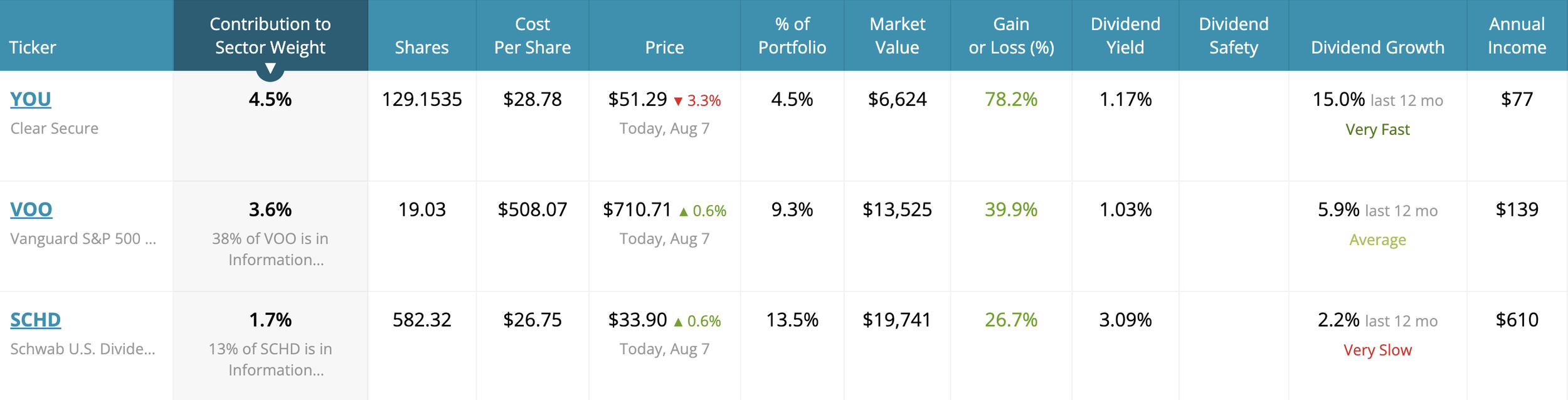
While Clear Secure (YOU) is the only individual stock in my portfolio that’s officially classified in the technology sector, I own other companies that I would consider very tech-forward despite technically belonging to other sectors. Visa (V) is a great example of that.
Source: Simply Safe Dividends
With that said, I am undeniably underweight technology compared to the broader market. But believe it or not, once you account for the tech exposure I get through VOO and SCHD (both of which I dollar-cost average into every week), technology actually makes up about 10% of my overall portfolio. That puts it pretty much in line with most of the other sectors I own.
A lot of people seem to think I intentionally avoid buying tech stocks, but the truth is that I just don’t feel the need to force more exposure to the sector when it's already such a large portion of the broader market, which becomes an increasingly larger portion of my portfolio every week.
In other words, I don’t feel like I need to go out of my way to buy individual tech stocks just for the sake of having more tech. Funds like VOO and SCHD already give me a growing amount of exposure to the sector, and if I eventually find an individual tech stock that I really like, I’d have no problem owning it.
Have a question? Ask me here to see it featured in an upcoming newsletter.
LAST WORD 👋
I recently started a brand new YouTube channel where I react to personal finance, investing, and money-related content from around the internet.
So far, I only have a few videos out on the channel, but I'm posting at least one or two videos a week on there.