These High-Yield Dividend Stocks Are Absurdly Cheap
Disclaimer: This page contains some affiliate links that might just lead you to the promised land of awesomeness (or at least some cool products). I may receive commissions for purchases made through links in this post.
One of the best things about dividend investing is that there’s a bright side to every downside.
Most investors — especially those who just want to flip their shares for a profit — hate seeing their stocks go down. But for dividend investors, who are constantly looking to buy more shares and generate more passive income, lower share prices can actually work to your advantage.
For one, a lower share price means you can buy more shares for the same amount of money. Or in other words, you can get more for less.
But it gets even better because a stock’s dividend yield moves in the opposite direction of its share price. So when the price of a dividend stock goes down, not only can you buy more shares for the same amount of money, but those shares also come with a higher starting dividend yield. It’s a win-win.
There’s always a silver lining for dividend investors, and today we’re looking at three stocks whose share prices have been on the down and out, pushing their starting dividend yields up in a pretty big way.
Stock #1 — Hormel (HRL)
You’re likely already pretty familiar with Hormel (HRL), which owns a wide variety of household brands like SPAM, Skippy, Planters, Corn Nuts, Jennie-O, Applegate, Justin’s, and La Victoria. You can see the full lineup here.
So far, 2026 has not been good for Hormel’s share price, with the stock down about 12% just this year. Zooming out over a longer period of time, things look even worse, with shares down more than 50% over the past five years.
CPG companies in general have had a tough time these past few years, but Hormel specifically has struggled with commodity inflation (on things like meat, nuts, etc.), higher labor and freight costs, and other challenges that have squeezed their profitability.
Things seem to be turning a corner for the company though. In its most recent quarterly earnings, EPS grew 6% year-over-year, while operating margins saw a slight expansion.
Management also raised the bottom end of its full-year EPS guidance, and now expects earnings to grow between 6% and 10% this year. So things are looking up.
Source: Simply Safe Dividends
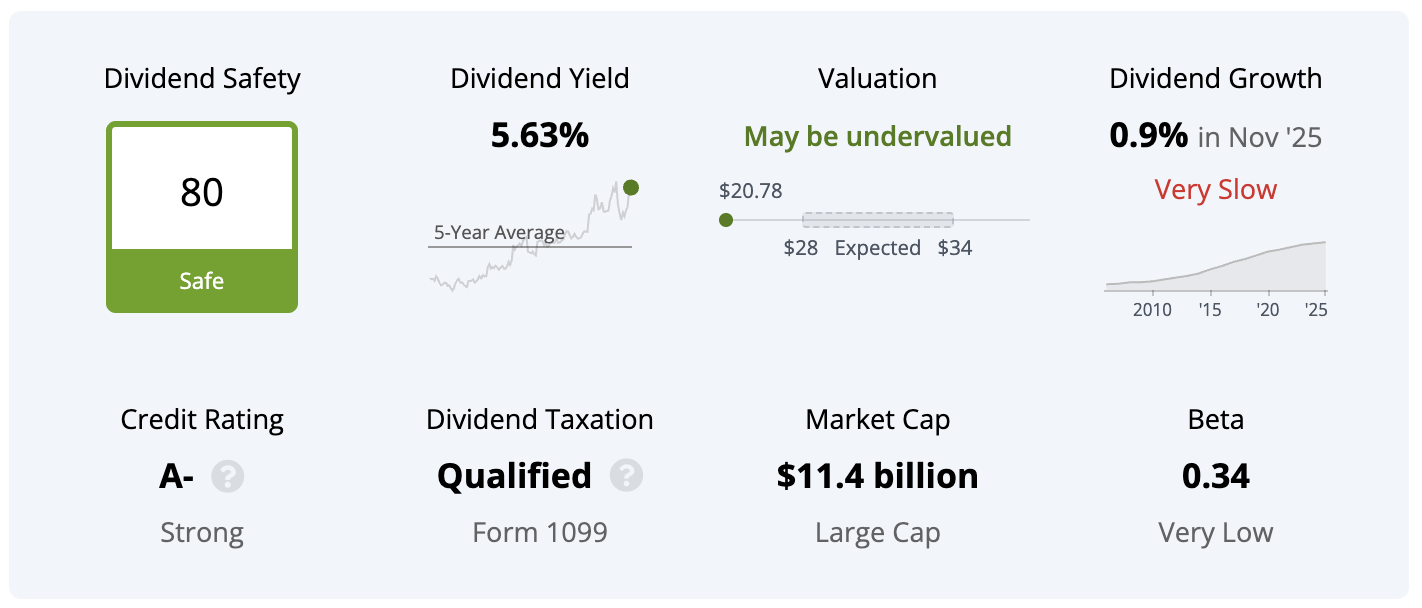
In the meantime, one benefit of this substantial share price decline is that shares of HRL are currently yielding 5.6%, which is considerably higher than their five-year average yield of around 3.5%.
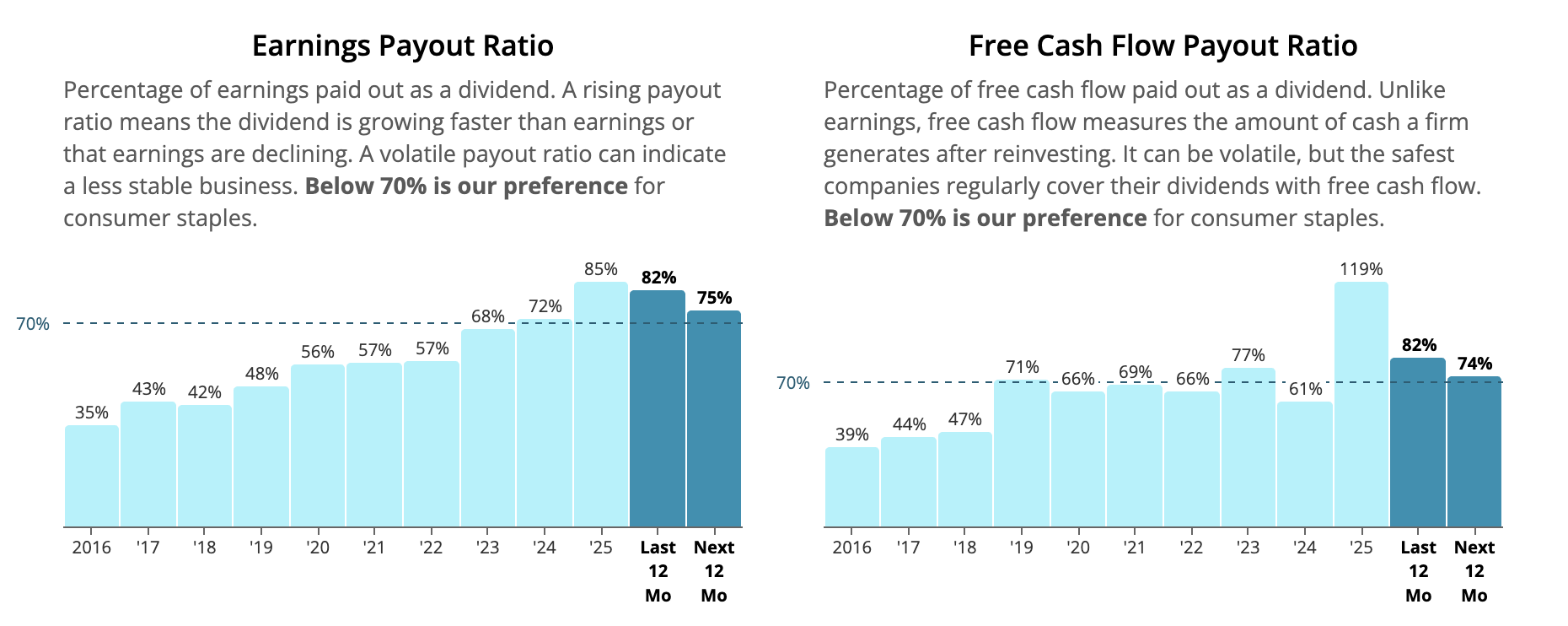
Hormel is also a Dividend King with 60 consecutive years of dividend growth, and Simply Safe Dividends (which you can try free for two weeks here) gives the company a Dividend Safety Score of 80, meaning the chances of a dividend cut look to be pretty low over a full economic cycle.
Source: Simply Safe Dividends
There still looks to be some dividend coverage left as well, with both the earnings and free cash flow payout ratios sitting at around 80%.
Of course, that continued coverage depends on Hormel’s ability to grow its profits and free cash flow, so we’ll see what the rest of this year brings in that department. The recently raised guidance is certainly a good sign though.
Stock #2 — Sanofi (SNY)
Next up is Sanofi (SNY), a French biopharmaceutical company and probably the most obscure name on our list today.
Sanofi is probably best known for Dupixent, a blockbuster drug used to treat inflammatory conditions like eczema and asthma. But the company also has a large vaccine business and develops treatments across areas like immunology and neurology.
Like Hormel, shares of Sanofi are down about 12% so far this year and about 11% over the past five years. A big reason for that looks to be concerns surrounding Sanofi’s future growth prospects, particularly its heavy reliance on Dupixent.
Dupixent has become an absolute monster for the company. In the most recent quarter alone, sales soared nearly 38% to €5.2 billion, and Sanofi now expects the drug to generate around €25 billion in annual sales by 2030.
That’s obviously great for Sanofi today, but it also creates a problem: the larger Dupixent becomes, the more Sanofi will eventually need to replace that growth as the drug approaches patent expiration in the 2030s.
And recent setbacks in Sanofi’s drug pipeline haven’t exactly quelled those concerns. The company has shelved a handful of development programs, and its new CEO has openly talked about the need to improve the company’s R&D pipeline.
Despite those concerns, though, Sanofi’s underlying business is crushing it right now. In the most recent quarter, sales grew 17.8% at constant exchange rates while EPS increased 33.3%, which prompted management to raise its full-year guidance.
Source: Simply Safe Dividends
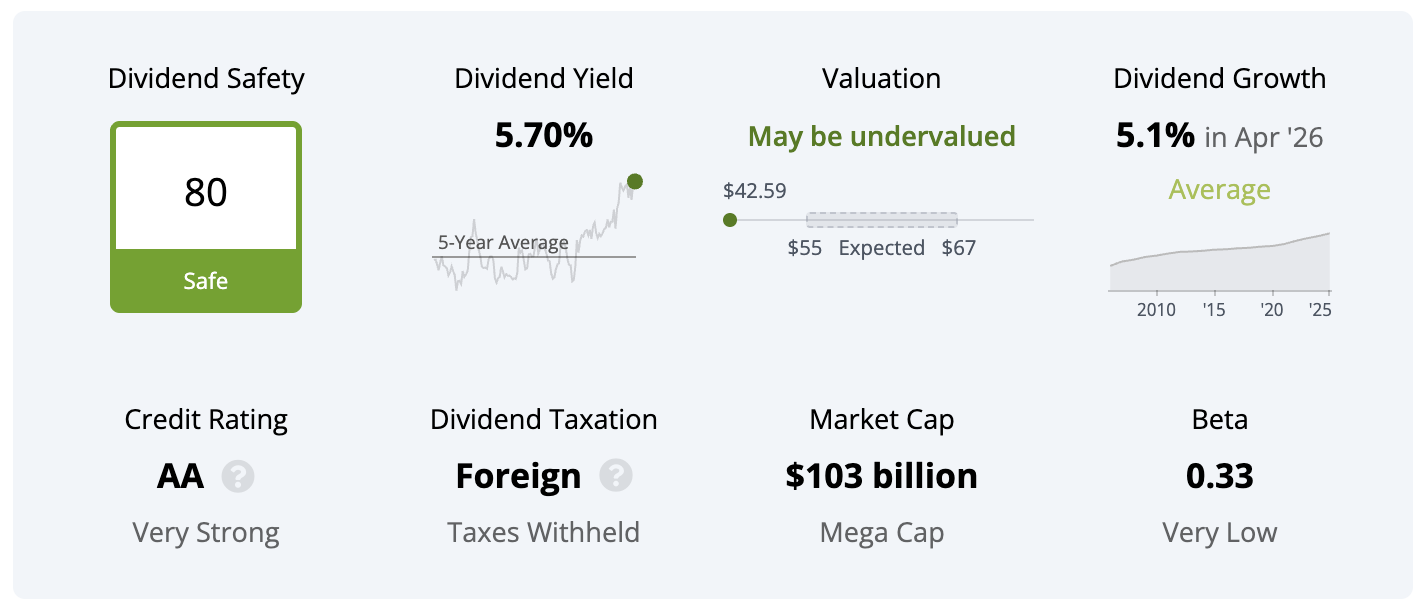
On the dividend side of things, you can currently lock in a starting yield of around 5.7%. That’s already pretty high in its own right — especially for a pharmaceutical company — but it’s also quite a bit above Sanofi’s five-year average yield of around 4%.
It’s also worth noting that Simply Safe Dividends gives Sanofi a Dividend Safety Score of 80, right up there with Hormel.
Source: Simply Safe Dividends
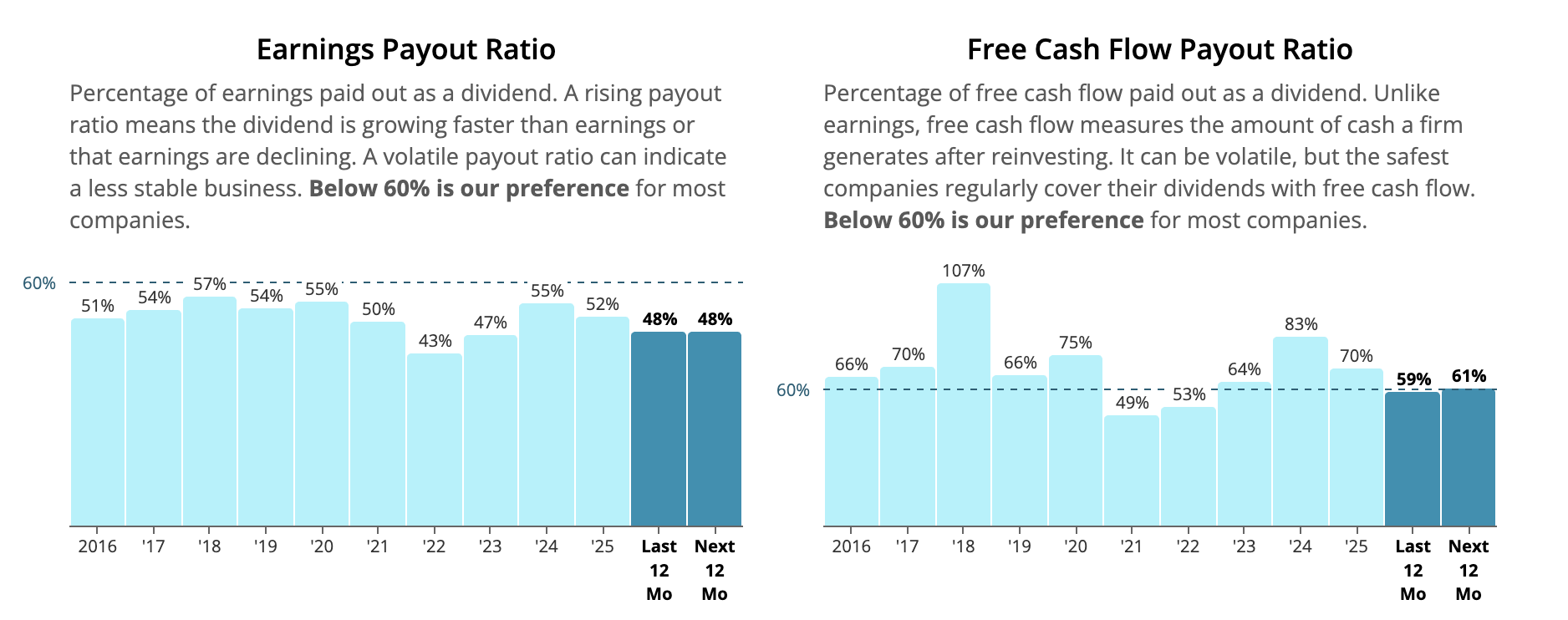
Fortunately, the payout ratios look much lower than what we saw with Hormel. Sanofi’s earnings payout ratio is only around 50% over the last twelve months, while the free cash flow payout ratio isn’t even 60%.
Both leave plenty of room to continue paying and growing the dividend, which Sanofi has now done for 30 consecutive years.
Stock #3 — VICI Properties (VICI)
Last up is VICI Properties (VICI), which I’ve talked about quite a bit recently. In fact, VICI was my top dividend stock to buy back in July, so rather than rehash everything in this article, you can read my full breakdown of the company here.
Despite the business continuing to grow, VICI’s share price has been struggling big time. So far in 2026, shares are down about 12%, leaving them down about 18% over the past five years.
Source: Simply Safe Dividends
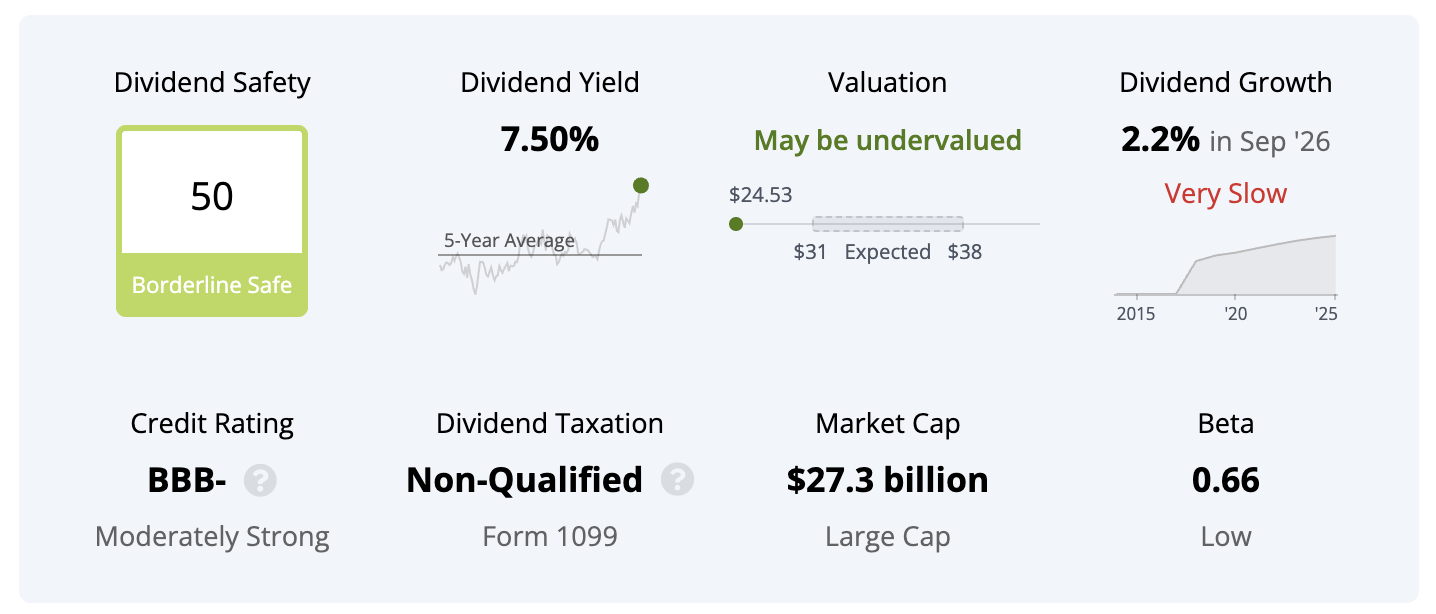
With that drop, VICI is currently yielding close to 7.5%, which I believe is an all-time high for the company.
It’s also worth noting that VICI just recently raised its dividend another 2.2%, which is at least a sign of confidence from a company currently facing quite a few headwinds.
Source: Simply Safe Dividends
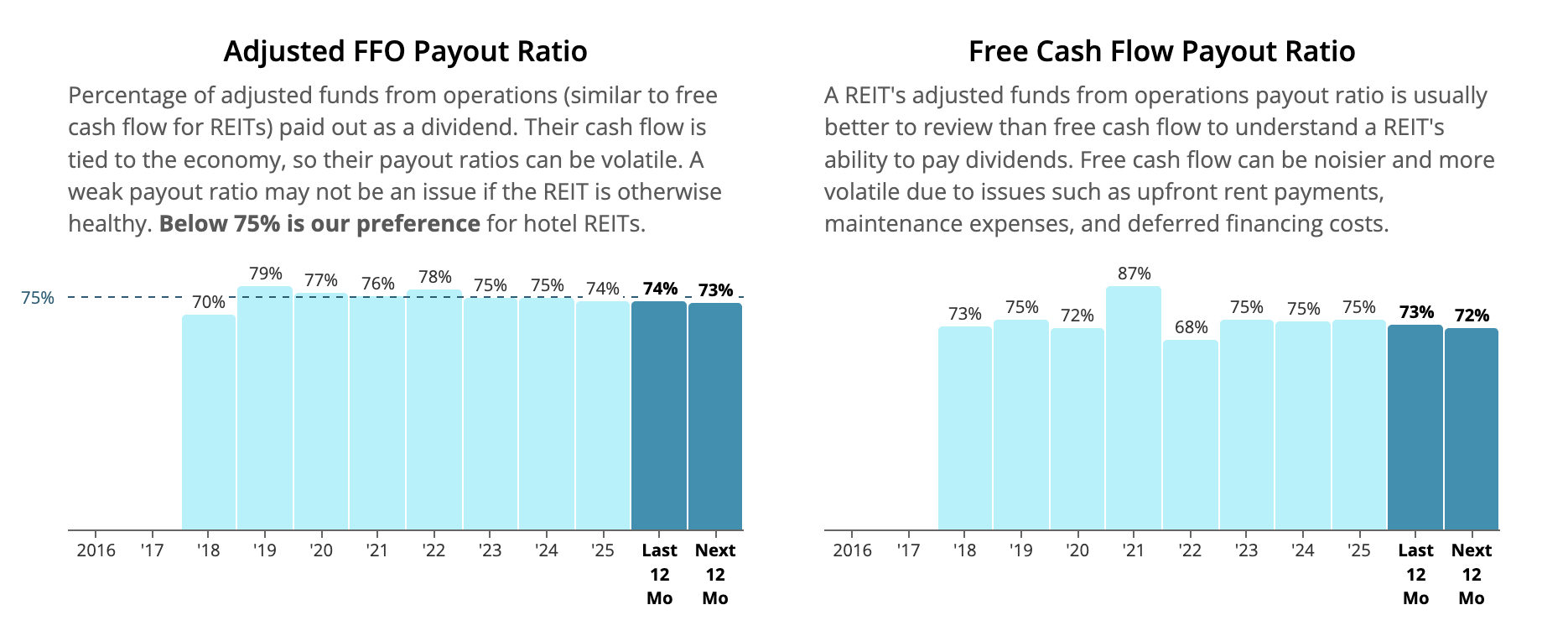
Despite those headwinds — and a Borderline Safe Dividend Safety Score of only 50 — the dividend itself still looks pretty well covered.
VICI’s AFFO payout ratio is currently sitting in the low-to-mid 70% range, which is actually slightly below its historical average, while AFFO per share continues to climb.
Still, the situation with VICI is pretty fluid right now. Between concerns surrounding some of its tenants, changes in interest rates, and worries about tourism here in Las Vegas, it could continue to be a bumpy road ahead for the company.
Having said all of that, though, I’d love to hear from you: Are there any other beaten-down dividend stocks you’re buying right now? Write to me here and let me know.
Dividend Investing Democratized
Join thousands of savvy investors in the pursuit of early retirement. Get Retire With Ryne delivered straight to your inbox every week as you build your perpetually growing, cash-flowing dividend stock portfolio.
IN MY PORTFOLIO 📈
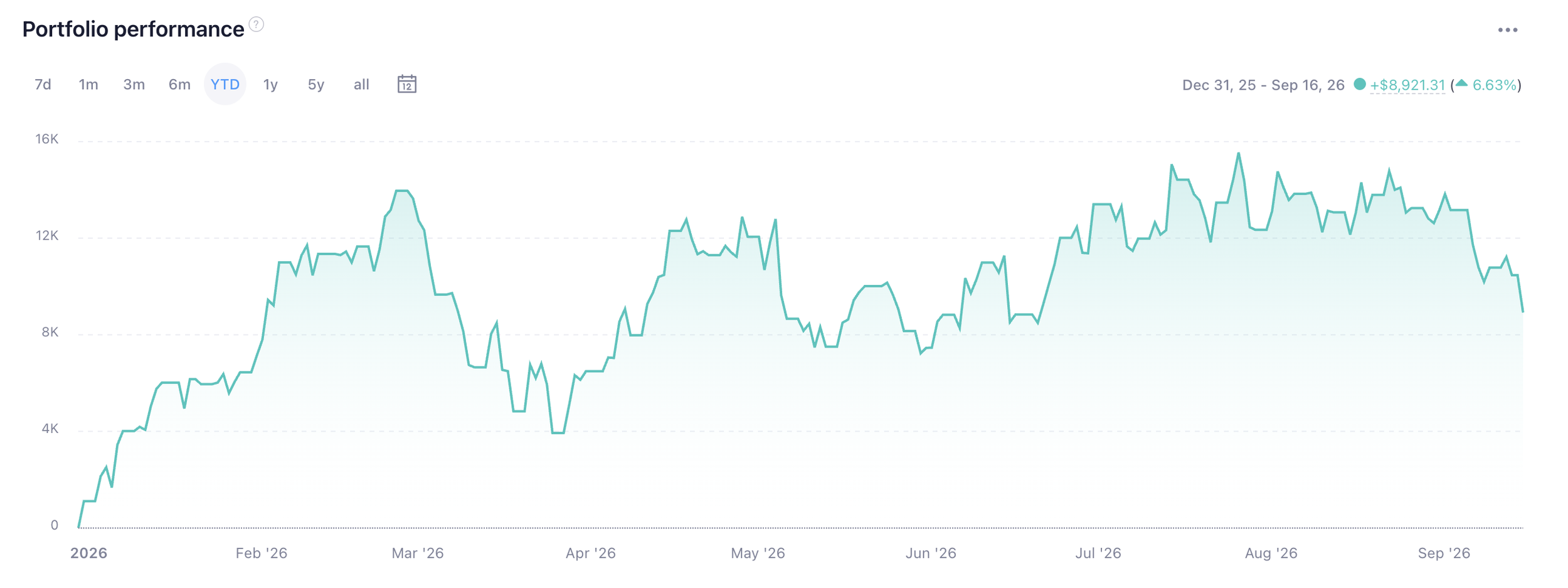
See my full portfolio with all of my holdings, trades, and dividends on Snowball Analytics! Plus, use code "rynewilliams" at checkout to get 10% off your subscription.
ICYMI 🎥
A small victory nearly five years in the making.
CAREFULLY CURATED 🔍
📺 Going To The Dogs - Zoetis has been getting absolutely hammered, but Adam Kahn thinks the market has gotten way too pessimistic. Here's why.
🎧 The Hard Part - Investors are constantly told they need to do something. Chris Mayer and Robert Hagstrom make a pretty strong case that sometimes the best move is doing absolutely nothing.
📚 The Buffett Paradox - The greatest investor of all time thinks most people shouldn’t pick stocks. Simon Evan-Cook explains why Buffett's contradictory advice actually makes sense.
SINCE YOU ASKED 💬
"What is the most important fundamental you observe when analyzing a stock?"
- Deyan | YouTube
I honestly couldn’t tell you one particular metric that’s more important than everything else. There really isn’t one magic silver bullet when it comes to analyzing a company.
However, the metric that probably comes the closest, and does seem to serve as an all-encompassing litmus test for the quality of a business, is return on invested capital (ROIC). ROIC essentially tells you how effectively a company is allocating its capital and generating returns, which can tell you a lot about the quality of the business and its management team.
It can also give you some idea of the returns you might see as an investor over time. As Warren Buffett and Charlie Munger have talked about, over a long enough period, the returns you earn as an investor will probably end up being pretty comparable to the returns the underlying business is able to generate on its capital.
With that said, there are two other fundamentals that really get me excited when I see them in a company. The first is little to no debt.
This is something I’ve become more fond of over the past few years. And let me just say that I don’t think debt is necessarily bad. I own plenty of companies that use leverage, and certain types of businesses, like REITs, rely heavily on debt to grow.
But for a normal company, I get really excited when I see little to no debt on the balance sheet because it’s just one less thing the company (and you as an investor) has to worry about.
The fact of the matter is that the world is messy, chaotic, and things tend to happen when you least expect them to. And when those things inevitably occur, a company with minimal debt is in a much better position to survive them.
At the end of the day, that’s really what it’s all about: survival. It’s about staying in the game and having the ability to outlast whatever gets thrown your way, and having no debt only improves a company’s chances of doing that.
I think that becomes especially important if you’re a long-term investor who plans to own these companies for decades. We always talk about wanting to buy and hold forever, and while it doesn’t always work out that way, I think your chances of doing so are a lot higher when you’re dealing with a company that isn’t weighed down by a bunch of debt.
The other fundamental I really gravitate toward is free cash flow. Obviously, this is especially important for us as dividend investors because a company pays its dividend from its free cash flow. So if you’re looking for a business that has the capacity to not only continue paying its dividend, but grow it well into the future, look no further than the free cash flow.
Putting all of this together, a company that earns high returns on its capital, has little to no debt, and generates plenty of free cash flow is going to check a lot of boxes for me. It’s hard to go wrong investing in a company like that.
Have a question? Ask me here to see it featured in an upcoming newsletter.
LAST WORD 👋
I love hearing from you all, and I'm always looking for feedback. How am I doing with the newsletter? Is there anything you'd like to see more or less of? Which aspects of the newsletter do you enjoy the most?
Your insights on these matters are essential in making this newsletter the best it can be. If you want to help, take a moment to share your thoughts by completing this quick form. It'll take you less than 60 seconds - guaranteed.
Thanks in advance!