The Exit Strategy: My Investing Origin Story
Disclaimer: This page contains some affiliate links that might just lead you to the promised land of awesomeness (or at least some cool products). I may receive commissions for purchases made through links in this post.
Planting the Seeds
When it comes to investing, most people can pinpoint the exact moment where the lightbulb turns on for them. For me, that moment didn’t come until my mid-twenties, but the seeds were planted much earlier.
I don’t remember exactly how old I was — somewhere in my teens, I think. But at some point, my parents set up custodial accounts for me and all of my siblings.
From that point on, every Christmas, every birthday, every Arbor Day (honestly, any time a gift was involved), we weren’t getting Grand Theft Auto or anything like that. We were getting money for our Charles Schwab accounts, which quickly became a running joke in our family.
Money that you can’t actually spend is probably the least exciting gift you can get as a kid, as I’m sure you can imagine. It’s right up there with a gift card to the podiatrist’s office.
So we’d always give our parents a hard time about it, and they’d always respond the same way. They’d say: “Someday you’ll be glad we did this for you.”
Sure enough, they were right. But it took a long time for me to understand that.
Even as I entered young adulthood, investing was still pretty low on my list of priorities. I remember a point in my early twenties when my roommate at the time started putting some money into Acorns. This was when investing apps were still relatively new, and I thought it was a cool idea, but I still didn’t really “get” investing yet.
I knew I had this Schwab account, which for some reason still felt uninteresting to me. But Acorns was automated, and the app was sleek and modern, which I guess made it feel easier and maybe a little cooler.
So I ended up putting a bit of money into it myself. At the time, though, I was working a low-wage job, paying rent, spending hours at the gym every day, and going out to the bars on the weekends — normal early twenties stuff.
So I didn’t have much money to dedicate to it. My contributions were sporadic at best, and investing was more of an afterthought than anything else.
Fast forward a few years, though. And everything changed.
The Awakening
In my mid-twenties — a few years after the Acorns era — I had a job that, to be honest, made me miserable.
I was working darn near seven days a week, not getting paid nearly enough (in my opinion, at least), and dealing with constant stress. Looking back, it was the only truly unhappy period of my life.
During that time, I was rarely in a good mood, and I wasn’t much fun to be around. I knew it then, but I feel okay saying it out loud now — with the benefit of hindsight — that I was probably dealing with some level of depression. That job really did a number on me.
I don’t remember exactly where I saw it, but somehow I came across a quote from Warren Buffett. I probably didn’t even know who he was at the time. It was that classic line:
“If you don’t find a way to make money in your sleep, you will work until you die.”
Given the situation I was in, that hit me like a freight train.
I remember thinking, “There is no way I’m working this job for the rest of my life.” If that was going to be my destiny, I wasn’t going to make it very long.
But that was the spark. That was the moment where investing stopped being this stuffy, boring thing that my dad always talked about, and it started to make sense. I finally understood why people invest.
You do it so you don’t have to work if you don’t want to. You invest to gain ownership over your time and your life. Investing is the exit strategy.
For me, it became the light at the end of the tunnel. And looking back, few decisions have had a bigger impact on my life than choosing to start and take it seriously.
Connecting the Dots
I started getting serious about investing around the same time the pandemic hit. I was home a lot, definitely not going out much, and suddenly I had all this time to learn how it all works — because at that point, I really had no idea what I was doing.
So I did what most people do to learn about things these days. I went to YouTube.
That’s where I was first introduced to guys like Graham Stephan, Jeremy Lefebvre from Financial Education, and Andrei Jikh. Through them, I got my first exposure to dividend investing, which led me to creators like PPC Ian, Russ Knopf, Darth Dividends, Bruce Wang, GenExDividendInvestor, and a bunch more.
The more I watched, the more it clicked. Dividend investing just made sense to me. Being brand new to all of this, the concept was incredibly easy to wrap my head around.
You buy shares of recognizable, everyday companies like Procter & Gamble, Coca-Cola, Pepsi, McDonald’s, Starbucks, Microsoft, etc. And just by owning those shares, they send you regular paychecks.
The idea of getting paid just for being a shareholder made my “exit strategy” crystal clear. All I needed was for my dividend income to eventually exceed the income from my job. Once that happened, I wouldn’t need the job anymore.
And the way it works made sense too. You start small, collect dividends, and then you reinvest those dividends. Now you own more shares.
Then the next time those companies pay you, the dividend is a little bigger. And if you repeat that process over and over again — basically into perpetuity — it compounds into something substantial.
The hard part for most people, I think, is at the beginning when you’re only getting a couple dollars here or a few cents there. It feels like reaching the point where your dividend income actually makes a difference is going to take forever.
Fortunately for me, I was already comfortable with the idea of delayed gratification from being into health and fitness. I’ve been into working out and weightlifting since right after high school, and a lot of those same principles translate perfectly to investing.
You don’t walk into the gym on day one and immediately start benching 225. You start with the bar, and you build from there.
Building a dividend portfolio is the exact same thing. Small, consistent progress over time.
Where It’s Taken Me
At this point, I’ve been investing for about six years. And in that time, I’ve gone from basically zero dollars in dividend income to averaging close to $400 every single month. And because of the power of compounding, it’s only going to grow faster from here.
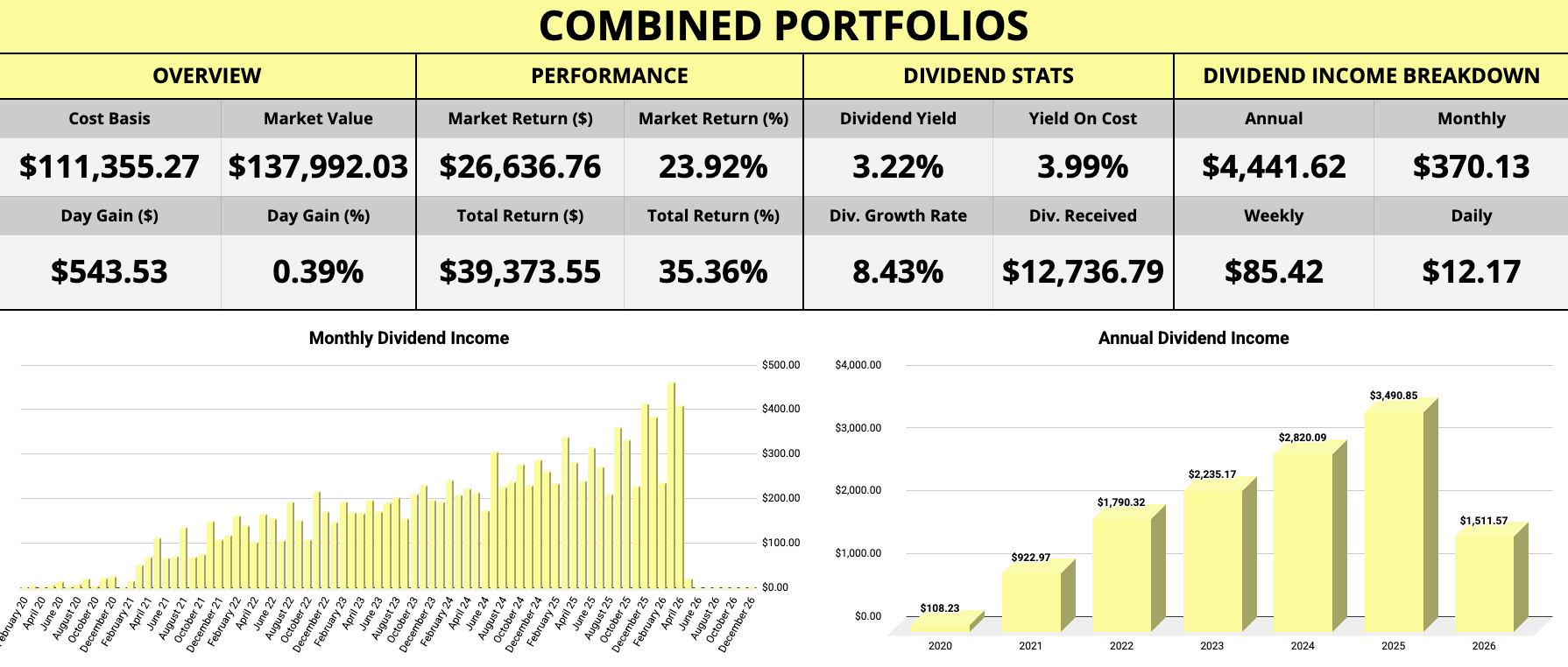
My portfolio as of May 6th, 2026
Investing has taught me a lot — not just about money, but about life. And if there’s anything to take away from my journey so far, it’s this:
You don’t have to be a genius to be an investor.
You don’t need a finance degree. You don’t need to be a Wall Street analyst. If I can figure this out and make it work, truly anyone can.
And second: this is one of those things that just gets better the longer you do it. If you can stay disciplined and consistent over time, you will be rewarded.
I say this all the time, but dividend investing really is the gift that keeps on giving. And it has completely changed my life in the handful of years I’ve been doing it.
Not only am I financially better off, but it’s also changed the way I think about life.
Most people think investing is about hoarding dollars just for the sake of having more money. They think it’s primarily driven by greed, but investing is really about having total ownership over your time.
It’s about being able to do what you want, when you want. And I think, at the root of it, that’s what we’re all really after — complete freedom. Investing is a means to that end.
We only get one shot at this life. And I believe it’s too short to spend it doing things you don’t enjoy just to make ends meet, instead of doing the things you actually want to do because your needs are already taken care of.
Still, financial freedom isn’t something you achieve overnight. You have to do some things you don’t like, at least for a while. But financial freedom is something that anyone can work toward, and I think everyone needs to start as soon as possible.
Even though it starts slow, don’t let that deter you. The snowball starts rolling sooner than you think. All you have to do is get started, and just keep going.
P.S. — That Charles Schwab money is now my favorite gift. And it’s a tradition that I will be sharing with my kid. I’m sure she’ll love it…eventually.
Dividend Investing Democratized
Join thousands of savvy investors in the pursuit of early retirement. Get Retire With Ryne delivered straight to your inbox every week as you build your perpetually growing, cash-flowing dividend stock portfolio.