Disclaimer: This page contains some affiliate links that might just lead you to the promised land of awesomeness (or at least some cool products). I may receive commissions for purchases made through links in this post.
In my opinion, there are few better ways to start the day than with a good book and a hot cup of coffee.
It’s a routine I try to stick to every morning (though it doesn’t always work out that way), and I never seem to get tired of it. In fact, it’s one of the things I look forward to most.
I keep a collection of my book notes (which you can read here), and historically, most of the books I’ve read have been about investing and personal finance, which is probably no surprise.
Over the years, I’ve probably read between two or three dozen different books on the subject (you can check out all of my recommended reads here), and after a while, it seems like many of them start saying the same things.
When I think about it, that’s probably a good problem to have. It means I’ve actually learned something from the books I’ve read. But it also makes it harder to get through new ones when they start to feel too familiar.
Even Morgan Housel’s latest book, for example—I couldn’t make it through the first couple of chapters. I just felt like I’d read it all before.
That was kind of the final straw for me. At that point, I realized I probably needed to take a (possibly long) break from personal finance books and spend some time reading about other subjects.
That decision recently led me to start reading a very interesting book: Barbarian Days by William Finnegan.
The book is an autobiographical narrative about the author’s lifelong relationship with surfing and how it shaped his life. I’ve always been into board sports—skateboarding, snowboarding, things like that—so I figured it would be a nice reprieve from reading about the corporate life cycle and returns on invested capital.
Last night, while reading, I came across a paragraph in the book that made me stop and think. I actually had to read it a couple of times.
It said:
“The close, painstaking study of a tiny patch of coast, every eddy and angle, even down to individual rocks, and in every combination of tide and wind and swell—a longitudinal study, through season after season—is the basic occupation of surfers at their local break. Getting a spot wired—truly understanding it—can take years. At very complex breaks, it’s a lifetime’s work, never completed. This is probably not what most people see, glancing seaward, noting surfers in the water, but it’s the first-order problem that we’re out there trying to solve: what are these waves doing, exactly, and what are they likely to do next? Before we can ride them, we have to read them, or at least make a credible start on the job.”
I’m sorry, but when I read that, I couldn’t help but think about investing. Is it just me, or can you see it too?
Even though the author was talking about surf spots, it was impossible for me not to read it in a way that relates to investing. In my head, the paragraph almost translated to something like this:
“The close, painstaking study of a tiny patch of the market—every business model and competitive advantage, even down to individual line items on a financial statement, and in every combination of interest rates, economic cycles, and market sentiment—a longitudinal study, through year after year—is the basic occupation of investors within their circle of competence. Getting a company wired—truly understanding it—can take years. With very complex businesses, it’s a lifetime’s work, never completed. This is probably not what most people see, glancing at the stock market and noting investors buying and selling shares, but it’s the first-order problem we’re trying to solve: what is this business doing, exactly, and what is it likely to do next? Before we can invest in it, we have to understand it—or at least make a credible start on the job.”
I guess I just can’t escape it. Everything, for me, somehow ties back to investing. Even surfing, apparently.
But I think that’s a big part of the fun of having this as a hobby. It also speaks to just how multidisciplinary investing really is.
Charlie Munger once described investing as a subset of worldly wisdom, and I think that’s exactly why it’s so important to step away from personal finance books every once in a while and spend time exploring other avenues.
In doing so, you can learn about investing in places you’d never expect. There are ideas in all kinds of fields that can sharpen your thinking as an investor—even surfing.
Which begs the question: what’s the takeaway for investors from this paragraph?
For me, it’s that deeply understanding a company doesn’t happen in one fell swoop. It’s an ongoing process that unfolds over time—sometimes a lifetime—as these living, breathing businesses continue to grow and evolve.
That work will never be fully complete, and that’s the fun of it. But before you invest in a company, you should at least be willing to embark on that journey.
As you do, you will start to notice patterns.
How does this business behave in a recession? How far into the future does management seem to think when making decisions? How effectively are they allocating excess free cash flow?
You often only learn these things after years of owning and studying a business. And you don’t have to know all of those answers the moment you buy a stock. But you do have to be willing to keep learning as you go.
Having said all of that, now I want to hear from you: What’s the most interesting investing lesson you’ve picked up from outside the world of finance? Write to me here and let me know.
Dividend Investing Democratized
Join thousands of savvy investors in the pursuit of early retirement. Get Retire With Ryne delivered straight to your inbox every week as you build your perpetually growing, cash-flowing dividend stock portfolio.

Blossom is a unique social platform created by investors, for investors. Unlike the usual social media platforms, Blossom is dedicated exclusively to discussions on finance and investing.
I've been actively posting on Blossom for a few years now and I absolutely love the community on there. With over 400,000 DIY investors, Blossom is buzzing with all sorts of different investment ideas. The coolest part is that you can see everyone's full portfolios (including mine), which you can automatically link within the app!
Picture Twitter/X, but with an added portfolio tracking feature and less trolling – that's Blossom for you. Personally, I find it much more enjoyable than my experience on Twitter/X, and I think you will too.
Download Blossom today, and follow me (@ryne) to see my entire portfolio and stay updated on all my real-time investment moves.
IN MY PORTFOLIO 📈
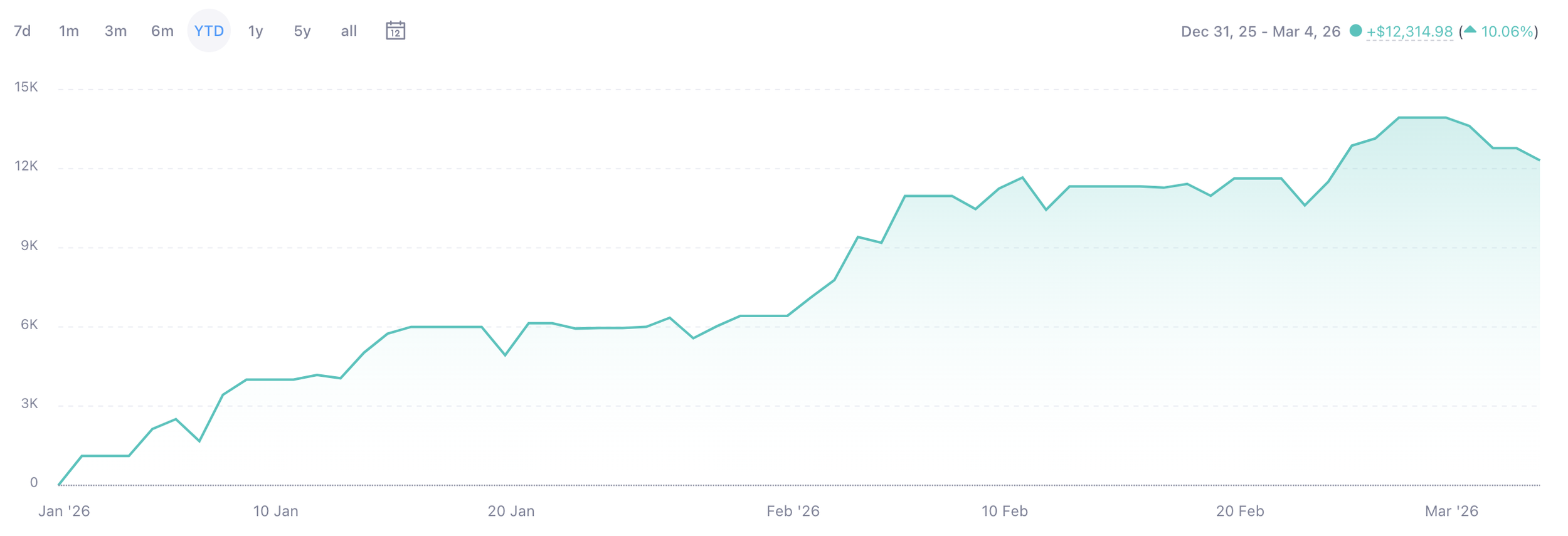
Start tracking your portfolio with Snowball Analytics today—free for 14 days! Plus, use code "rynewilliams" at checkout to get 10% off your subscription.
ICYMI 🎥
Is Investing ONLY About Returns?
In this episode of The Deep End, we dive into why most people will lose in the AI era — and it’s not because of the technology itself. From marathon mindset to investing ethics, we break down why discipline and mental strength will matter more than ever.
CAREFULLY CURATED 🔍
📺 Quality on Sale - My main man Russ shares nine cheap, safe, fast-growing dividend stocks that aren’t getting enough attention.
🎧 What Really Counts - In this episode of the Talking Billions podcast, Guy Spier talks about why survival is everything, how smart investors still lose it all, and why preserving your capital base should be the first priority in your portfolio.
📚 Compounding Craft - What a 150-year-old Kyoto tea caddy maker can teach us about long-term thinking.
SINCE YOU ASKED 💬
"What dividend exposure would you recommend to a 24-year-old?"
- @Sedincesko954 | YouTube
To be honest, there isn’t a set-in-stone percentage you should be shooting for.
A lot of people like to generalize and say that if you’re young, you should have less exposure to dividend stocks because you’ll be “sacrificing gains.” I don’t agree with that. Dividend-paying companies are not inherently worse investments, and there are plenty of examples to prove it.
Personally, I started investing at 26, and I’ve always liked the idea of getting a paycheck from the companies I own. That’s important to me, but it’s not important to everyone, and that’s perfectly fine.
So I think the real question is: what do you want from your investments? Do you want the regular paycheck from the stocks you own? Is that what motivates you?
If so, there’s nothing wrong with allocating more toward dividend stocks. If not, don’t sweat it.
What I wouldn’t do at 24 is load up on the highest-yielding stocks you can find. It’s not bad to own some high-yielders — and some have proven to be solid total return investments (MAIN is a good example). But at your age, with so many great compounding years ahead of you, now is not the time to go all in on high income.
Because you still have such a long time horizon, you'll be better off focusing on high-quality companies (or ETFs) that have the capacity to grow over the long term. And that’s true whether they pay a dividend or not.
Have a question? Ask me here to see it featured in an upcoming newsletter.