Warren Buffett’s Most Important Lesson for Investors

PRESENTED BY SNOWBALL ANALYTICS
Disclaimer: This page contains some affiliate links that might just lead you to the promised land of awesomeness (or at least some cool products). I may receive commissions for purchases made through links in this post.
First of all, happy New Year!
The start of 2026 obviously marks the beginning of something new (and hopefully fantastic). But this year, in particular, also marks the end of an era.
By now, you’ve probably seen the news: as of today, Warren Buffett is no longer at the helm of Berkshire Hathaway, officially closing the book on a 55-year run as the company’s CEO.
On one hand, it’s hard not to feel a little sad about that. For many of us, Buffett isn’t just an investor we look up to — he’s been a dependable guide on the journey to becoming better investors, better thinkers, and better human beings.
On the other hand, I can’t help but feel incredibly fortunate. We got to grow up as investors during a time when both Warren and Charlie were still around, still investing, and still teaching (and learning themselves). And I think we’re better off for it.
Even without ever meeting him, he’s taught millions of people about the business of investing, building wealth, and living an ethical life. He took ideas that are often made unnecessarily complicated and distilled them into lessons that were simple, clear, and timeless.
It’s often said that reading Warren’s annual shareholder letters will teach you more about business than getting an MBA. I’ve always loved that line, especially considering I never finished college.
For a while now, I’ve been taking notes on his annual letters. You can read my full notes here, broken down by year. And while I could easily pull a dozen great quotes to share with you today, there’s one in particular that really stands out.
It comes from Warren’s first annual letter to shareholders in 1977. More than almost anything else he’s written, I think this quote perfectly captures both the essence of investing and the way Warren and Charlie thought about owning businesses.
“We select our marketable equity securities in much the same way we would evaluate a business for acquisition in its entirety. We want the business to be (1) one that we can understand, (2) with favorable long-term prospects, (3) operated by honest and competent people, and (4) available at a very attractive price. We ordinarily make no attempt to buy equities for anticipated favorable stock price behavior in the short term. In fact, if their business experience continues to satisfy us, we welcome lower market prices of stocks we own as an opportunity to acquire even more of a good thing at a better price.”
This is basically the Berkshire Hathaway blueprint for investing. There’s a lot packed into this quote, so let’s break it down piece by piece.
First and foremost, the business has to be one you understand. If you don’t understand how it makes money, then you won’t be able to accurately wrap your head around its risks and competitive advantages.
Second, the business needs to have favorable long-term prospects. That doesn’t mean every year will be perfect, but it does mean the company should be positioned to be stronger five or ten years from now than it is today. A business that isn’t growing is declining, and that’s not a great foundation for building wealth over the long-term.
Third, you need to trust the people running the company. It seems like such a simple concept, but it’s often overlooked.
If management isn’t honest, transparent, and aligned with shareholders, nothing else really matters. You’re handing your hard-earned money to someone else, and if you don’t trust them with it, then you shouldn’t invest in it.
And finally, price still matters.
Even the best businesses can be bad investments if you pay too much for them. Buying at an attractive price gives you a margin of safety, which allows for some wiggle room if things don’t go the way you plan.
And if you’re truly investing for the long term (which you should be), unexpected risks will undoubtedly show up along the way.
There’s also something important in this quote that isn’t stated outright, but is clearly implied: When you buy a stock, you are buying a business. The two are one and the same, and it’s easy to forget that.
Many people treat stocks like they’re spinning a roulette wheel, but at the end of the day, stock investing is business ownership. Maintaining that mindset matters much more than whatever the share price is doing this week, this month, or this year.
If you take anything away from Warren Buffett’s career, let it be this: Invest like an owner, think long term, and let time do the heavy lifting.
With all of that said, now I want to hear from you: What’s your favorite Buffettism? Write to me here and let me know.
Dividend Investing Democratized
Join thousands of savvy investors in the pursuit of early retirement. Get Retire With Ryne delivered straight to your inbox every week as you build your perpetually growing, cash-flowing dividend stock portfolio.

One of the most essential tools for any investor is a reliable portfolio tracker, and Snowball Analytics is the ultimate command center for your portfolio, providing all the tools you need (and more) in one place.
Plus, it’s one of the only portfolio trackers out there designed specifically for dividend investors.
The layout is clean and intuitive, offering charts, graphs, and other features you didn’t even know you needed but now can’t live without—like the dividend calendar, portfolio backtest tool, and the dip finder tool (this has been a game changer).
I’ve been using Snowball for a couple of years now, and it's the most in-depth portfolio tracker I’ve ever used (you can see my entire portfolio on Snowball here). I highly recommend it to any dividend investor looking for maximum functionality and data for tracking their portfolio.
Right now, Snowball Analytics is offering a 14-day FREE trial so you can try it out risk-free. The best part is, if you end up loving it (which, as you'll find out, is not hard to do), you can save 10% on your subscription when you use code “rynewilliams” upon signing up.
IN MY PORTFOLIO 📈
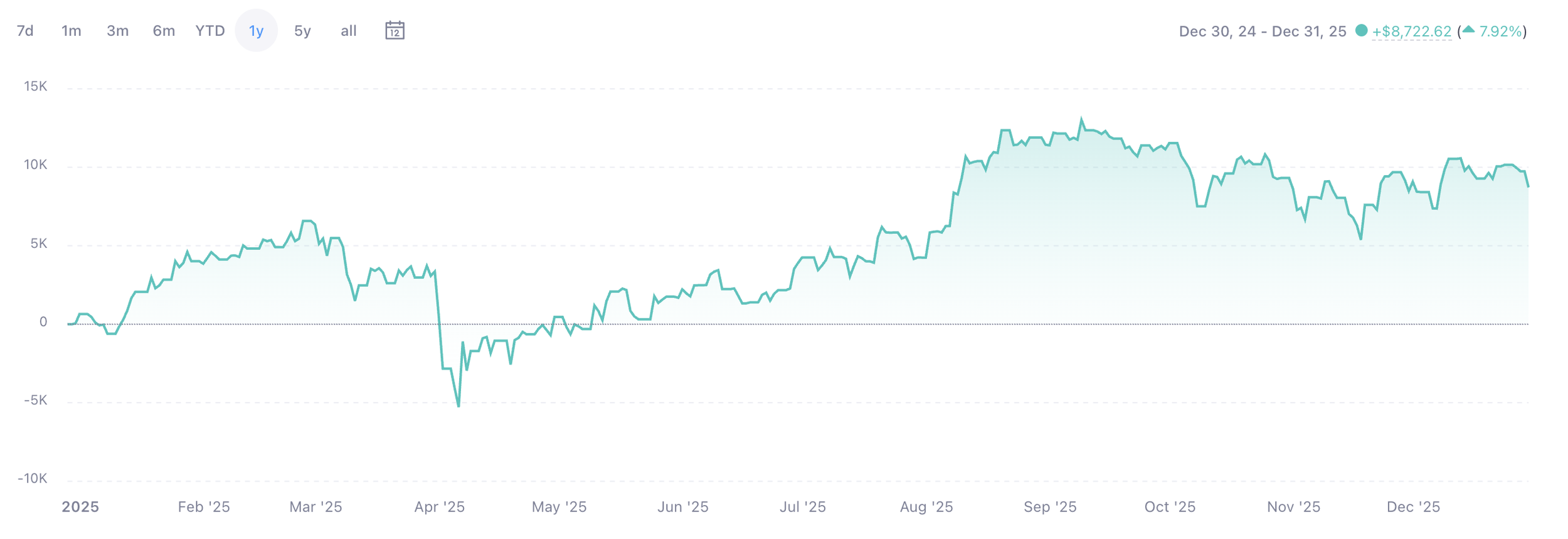
See my full portfolio with all of my holdings, trades, and dividends on Snowball Analytics! Plus, use code "rynewilliams" at checkout to get 10% off your subscription.
ICYMI 🎥
Our Investing Goals For 2026
In this episode of The Deep End, we close out 2025 by looking back at the investing goals we set for the year and how things actually played out. From there, we lay out our investing goals for 2026 and what we have our sights set on as we head into the new year.
CAREFULLY CURATED 🔍
📺 Grounds For Concern - Russ breaks down why there may be trouble brewing for Starbucks’ dividend, despite its long history of increases.
🎧 Avoid Disaster - A great reminder from Howard Marks that successful investing isn’t about swinging for home runs, but about managing risk and avoiding disaster over the long run.
📚 Rethinking Compounding - We tend to think of investing as climbing a mountain, but Bogumil Baranowski offers a more realistic analogy for how your wealth actually grows over time.
SINCE YOU ASKED 💬
"Which dividend stock surprised you the most last year?"
- Josh | YouTube
This is such a great question! And without even thinking twice, my mind immediately went to Johnson & Johnson (JNJ).
The stock was up over 45% for the year, which is definitely not what you'd expect from a “boring” Dividend King. In hindsight though, it probably shouldn’t have been that surprising since JNJ was my worst performer the year prior — down close to 10% — and it was widely considered to be "dead money" for a long time.
I’ve thought a lot about why the stock did so well in 2025, and while it’s hard to pinpoint a single reason, I think a big part of what kept it depressed for so long was ongoing concern around the talc litigation.
While those issues are still ongoing, the company has continued to work through them and has kept growing sales, earnings, and free cash flow along the way. And as JNJ continues to put up strong numbers, I think the market is being reminded that this is still a rock-solid, growing company despite the unresolved noise still going on in the background.
Fortunately for me, I was buying heavily before the stock’s substantial run-up. From June 2024 through February 2025, while shares hovered around $145–$150, I added nearly eight shares to my position, which are now up roughly 40–45%.
The takeaway for me, I think, is twofold. First, yesterday’s losers often become tomorrow’s winners (and vice versa). And second, over time, the share price will always follow the fundamentals.
Have a question? Ask me here to see it featured in an upcoming newsletter.